

by Diarmuid O’Callaghan, Library Assistant
Tales of sea monsters and obscure sea dwelling species have featured in the folklore and mythology of many countries spanning thousands of years. The Leviathan, a fierce sea creature, is the continuation of Lôtān, a seven-headed sea serpent whose story can be traced back to the Baal Cycle from Syria (1500-1300 BCE). The Kraken, often depicted as a giant squid whose massive tentacles would destroy ships and drown sailors was first recorded in 1180 by the King of Norway. Merfolk; a part human, part fish species have also been described in the mythology of several countries, more often described as part woman (mermaids) and were considered bad luck, whereby their presence predicted disaster and could often cause of it. But did you know that Ireland has its very own tales of sea monsters, and that their stories can be found in Special Collections?


The Oilliphéist
The origin of the Irish sea serpent can be traced back to Irish mythology, but it’s first mention is unclear. The Oilliphéist/Caoránach is the most famous of the Irish sea monsters. Described in the Dictionary of Irish Mythology as a fabulous, dragon-like beast.1 Its story coincides with that of St. Patrick, who famously banished all serpents on the island of Ireland. Before this took place, the Oillphéist, upon learning the news, attempted to escape. While fleeing to the Atlantic, the creature was said to have cut the ground in a path that would become the Shannon River. Saint Patrick was undeterred, and while he never banished it from the island, he sent the creature to Lough Dearg.

This story may be the inspiration for this image of a giant creature found in John Speed’s, ‘The Province of Mounster’ (1612), MP1 Leonard Collection. What is even more interesting when looking at this image is the connection the Oilliphéist has to music. In the image, a person is riding on top of the sea creature, playing the harp. In the story of the Oilliphéist, it was said to have once swallowed whole a drunken piper named O’Ruairc upon hearing his music. The piper continued to play inside the monster, annoying it to the point that it coughed him back up.
Cata, The Monster of the Shannon
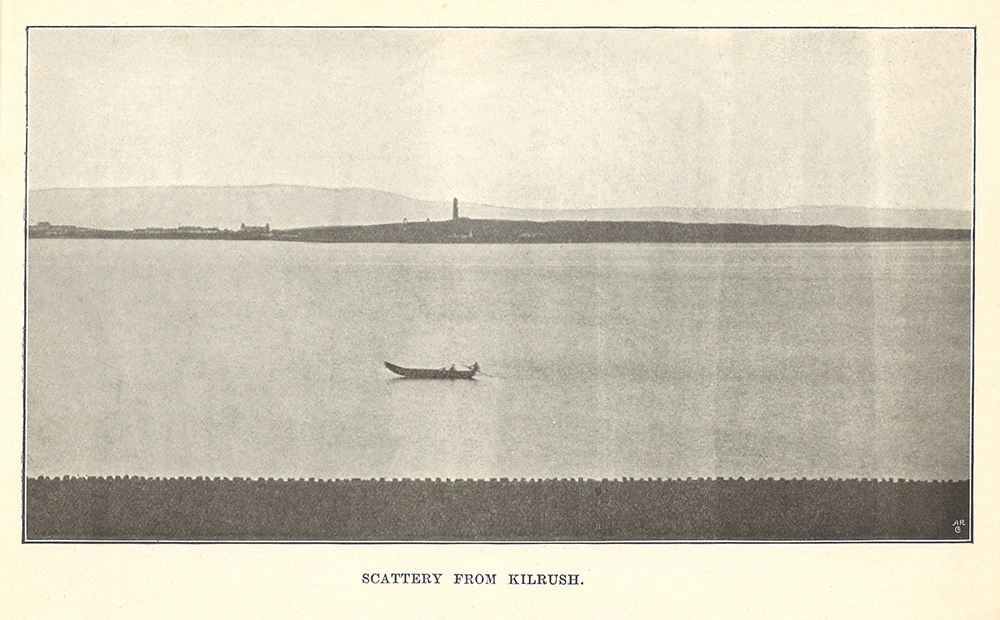
The Oillphéist is not the only sea creature described in Irish mythology. The Shannon has its own monster, the Cata. It was said to have dwelt by an island in the Shannon Estuary, off the coast of Kilrush in Clare. So feared was the creature that the island would be named Inis Cathaigh which translates to ‘The island of Cata’.
The creature and its story is described in the Irish manuscript, The Book of Lismore. The Book of Lismore is a 15th-century medieval manuscript, considered one of the “great books of Ireland.” Compiled for Fínghin Mac Carthaigh, the 10th Prince of Carbery, it contains 198 large folios with significant works of medieval Irish literature. This manuscript includes the lives of Irish saints, the only surviving Irish translation of Marco Polo’s travels, and tales of the hero Fionn mac Cumhaill.
In the manuscript, Cata was the islands protector, placed there by supernatural design to ensure no one set foot on what was a holy island. In the manuscript it is described as:
Hideous, uncouth, ruthless, awful was the beast that arose there. Longer was its body than Inis na h- Urclaide. A horse’s mane had it; an eye gleaming, flaming in its head, and its keen savage, forward, angry, edged, crimson, bloody, cruel, bounding. Two very hideous, very thick feet under it; behind it a mane. Nails hard as iron on it, which used to strike showers of fire out of the rocks of stone wherever it went across them. A fiery breath it had which burned like embers. A belly it had like the bellows of a furnace. A whale’s tail upon it behind. Hard, rending claws upon it, which used to lay bare, on the path they came, the surface of the ground behind the monster.
The creature was said to have killed all that came to its island.

Saint Senán & Inis Cathaigh
Senán mac Geircinn was an Irish saint, born in 488 AD and is said to have founded the island of Inis Cathaigh. Senán was one of the first prominent figures of Christianity in Ireland following the introduction of the religion to the country by Saint Patrick during the 5th century.


In his story, Senán was already a prominent religious figure when he was approached one day by an angel. The angel spoke of Cata’s island and told him that it was God’s will that he should reside upon it. Inspired and encouraged by his perceived protection of God, Senán came to the island and confronted the fierce sea monster. Making the sign of the cross with his staff, he banished Cata to Doo Lough in Mayo. Senán would then go on to become the first bishop of a famous monastery upon the island.

Recent Sightings
The banishment of the Cata by Senán did not mean the end of the sightings of the Shannon monster. A Limerick Chronicle report from 1871 accounts of a sighting of a monster near the Diamond rocks, with an enormous horse-like head, with a mane of sea-weed looking hair and large glaring eyes. The same report mentions a previous sighting from 1869 in Miltown Malbay where two men had seen a massive animal in the water with a long mane flowing from the neck, giving the appearance of a giant horse. In 1976, a letter by a captain of a sailing ship recounted seeing a creature while docked in Limerick port. He described it as the size and shape of a large submarine, with a twelve foot long neck and massive cone shaped hump. These accounts are found in the Shane Mac Olon book, Cata The Monster of Shannon Waves (1991) from the Leonard Collection.

It may be that this fantastic creature really is just one of many incredible stories in Irish mythology, but it won’t stop this writer from keeping a wary eye on the water whenever they’re near the River Shannon!

You must be logged in to post a comment.