
by Liam Timmins, 2024/25 student
In this letter, Dunraven discusses an offer by ‘Mr. Bailey’1 to become a major shareholder in a proposed cigarette company but stresses he lacks buying power and cash, noting past financial expenditure including an unfruitful £100,000 investment in ‘monotype’. Dunraven suggests that Mr. Bailey underwrites £10,000 cash in the company, he himself underwrites £50002 and then together form a company board and appeal for an additional £5000. He suggests forming this board with representatives local to Limerick including ‘Beauchamp’3, ‘Cleeve’4, or ‘John Barrington’5. He alternatively suggests approaching ‘Sir John Arnott’6 and ‘Sir T. Lipton’7 if their operations extended outside Limerick. In circumstances where Dunraven is unable to attend company meetings, he suggests ‘Ballingal’8 could represent him. Dunraven emphasises the urgency of making this investment and his concerns of competition entering the cigarette manufacturing business in Ireland, referencing existing tobacco companies ‘Goodbodys’ and ‘Gallahers’. Dunraven insists their company should have the power to negotiate a minimum price on their product with their competition9 agreed upon mutually or by an expert accepted by all parties.
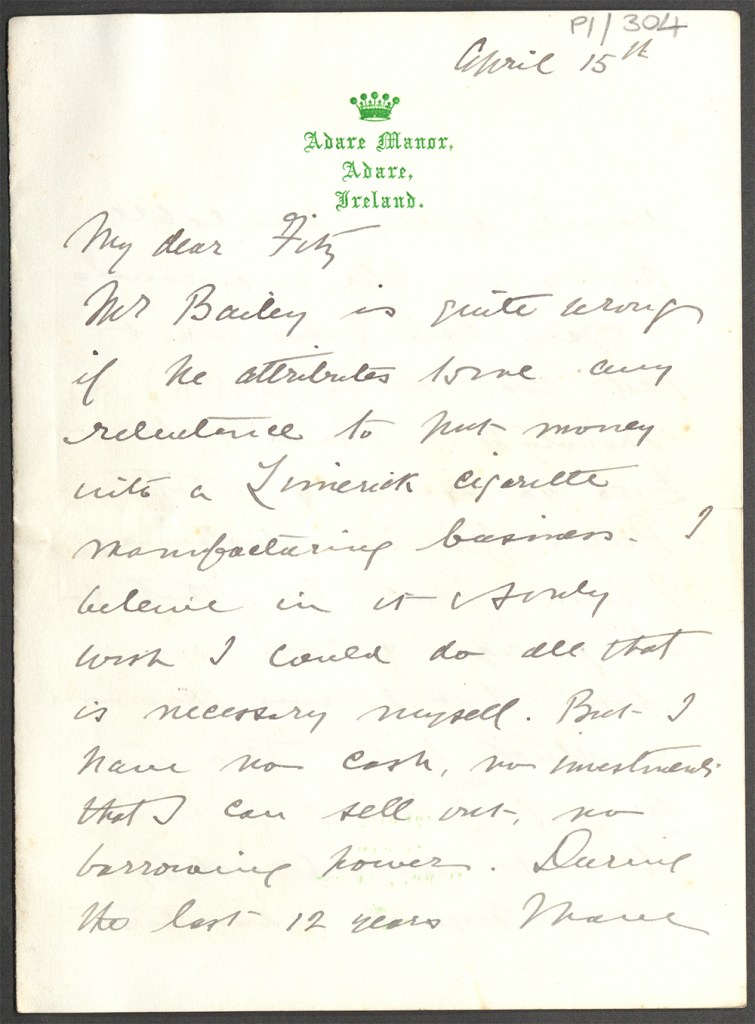
The letter was written on ‘April 15th’ noted within the script, while the year is archived in the Glin Paper catalogue as ‘[1905]’. These square brackets are used by archivists to indicate the year is not readily apparent in this letter but is deduced from other corroborating documents or sources, which are not indicated in this context. Dunraven’s mention of investing £2000 in his tobacco business may instead suggest the letter was written later, as this venture was only known to be founded in 1908 and tobacco growth was restricted in Ireland prior to the Irish Tobacco Bill 1907. Similarly, Michael Spillane, a student who conducted his PhD thesis on the 4th Earl of Dunraven, also mentioned this potential discrepancy and proposes the letter was written on April 15 1908 to coincide with Dunraven’s investments that spring sowing tobacco on his estate.
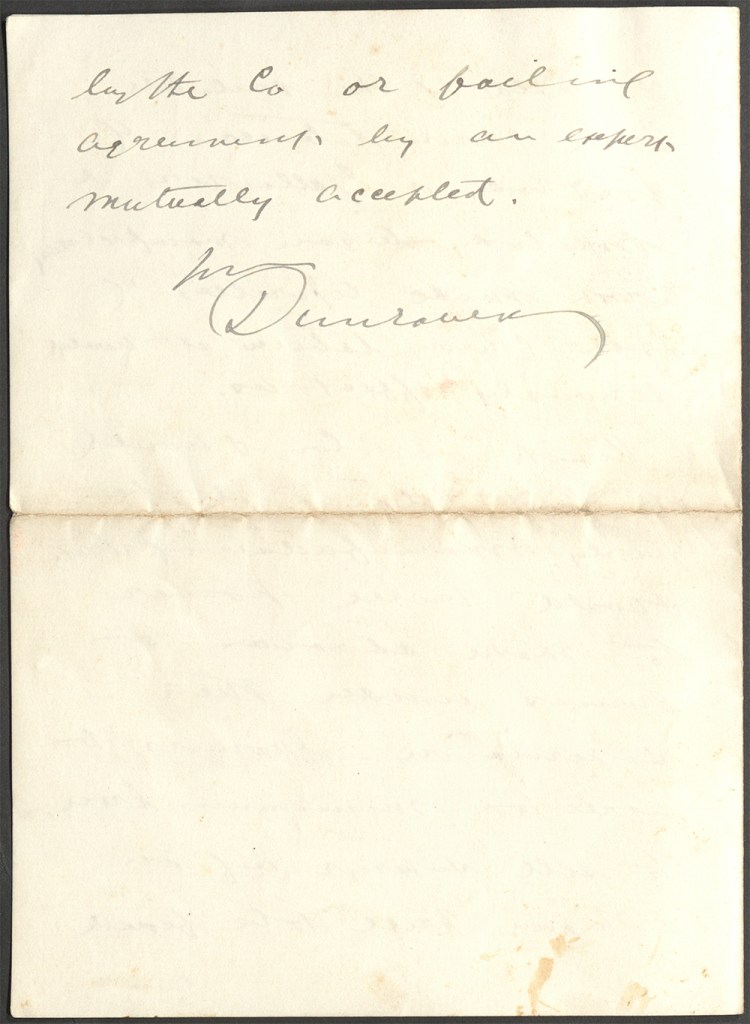
The letter is written across two A5-sized double-paged pamphlets for a total of 8 pages of written content, following a logical structure page-by-page continued from the first to the second pamphlet. A dark green Adare Manor printed logo and text can be found on the front page of each pamphlet. The letter is handwritten in cursive using black ink, and no margins are visible across the pages. The pages are slightly worn and stained, notably along the edges. There is also a crease visible dividing both pamphlets horizontally (possibly folded when the letter was stored). The presentation of the writing is quite neat, with no words being crossed out and no doodles present on the pages. No pages or content are missing from the letter. Dunraven uses some abbreviations in the letter including ‘Co.’ to refer to ‘company’ and an instance of ‘tho’ in place of ‘though’. He also often uses an ampersand variation10 to signify ‘and’. Occasionally Dunraven uses a hyphen (-) to extent his sentence or to act as a pause. Dunraven occasionally amalgamates two or more words in one pen stroke, sometimes making it difficult to distinguish them as separate words. Due to the small size of the pages, sometimes some longer words are cramped towards the end of the line or sometimes flow vertically downwards to accommodate space. Additionally his ‘c’s can often be difficult to distinguish from his ‘e’s. Regardless of its legibility, the sentiment of what Dunraven is conveying is clear within the context of the letter.
Please note all student submissions have been edited where necessary for accuracy and clarity.
- likely William Bailey, approx. 1853-1910[↩]
- £3000 in cash, £2000 in shares[↩]
- Willaim Beauchamp d.1918[↩]
- Thomas Cleeve 1844-1908, both co-owners of the Limerick Condensed Milk Factory[↩]
- likely John Beatty Barrington 1859-1926 who’s family founded the ‘Barrington’ hospital in Limerick[↩]
- potentially John Alexander Arnott 1853-1940 who’s family owned the Arnott Department Stores[↩]
- Sir Thomas Lipton 1848-1931, founder of Lipton Tea[↩]
- Robert Rennie Ballingall 1867-1928[↩]
- depended on the type of leaf[↩]
- similar to a lowercase ‘a’[↩]

You must be logged in to post a comment.