
by Adam Marnell, Student
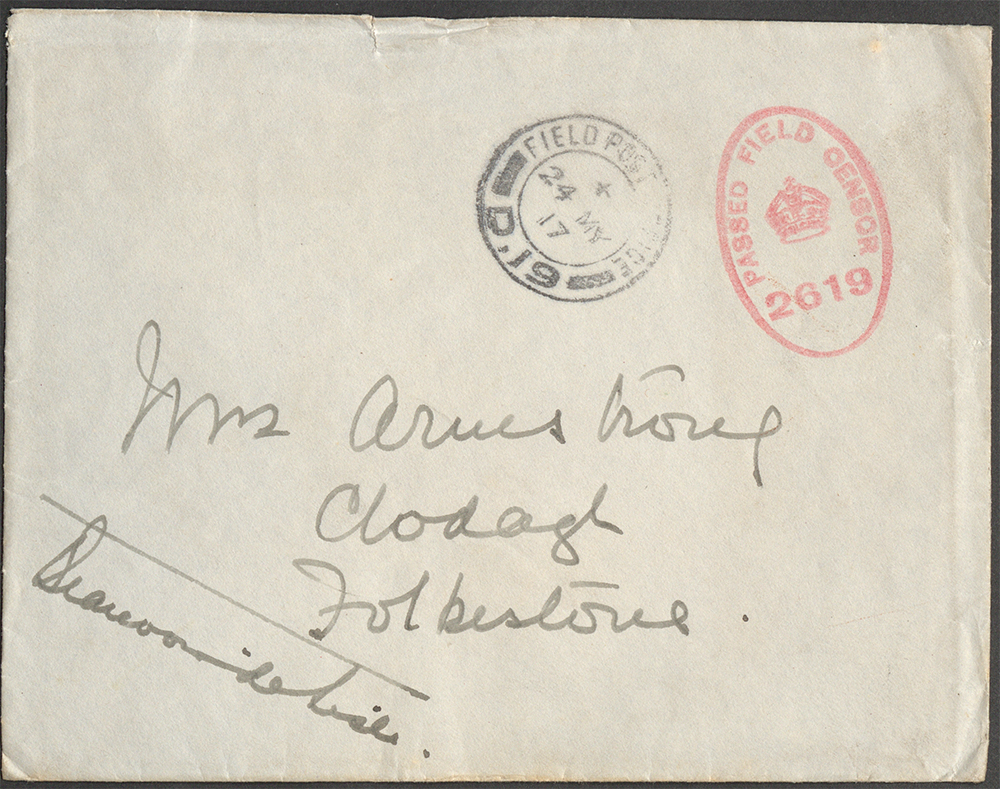
The first letter, P6/1246 (6) is a letter of condolence from General Henry Beauvoir de Lisle (1864-1955) to Pat’s mother Rosalie Cornelia Armstrong (1868-1956). The first thing to note is that the letter comes with an envelope, which has yellowed over time. The front of the letter gives some clues as to what the letter itself is about. The letter has two stamps on the front, one in black the other in red ink. The red stamp shows that the letter had been passed by a field censor, and the black stamp gives a date as to when it was posted, which was the 24 May 1917. Written on the middle of the envelope is the address of Rosalie, given as Clodagh, Folkestone, Kent, where she lived after becoming estranged from her husband.
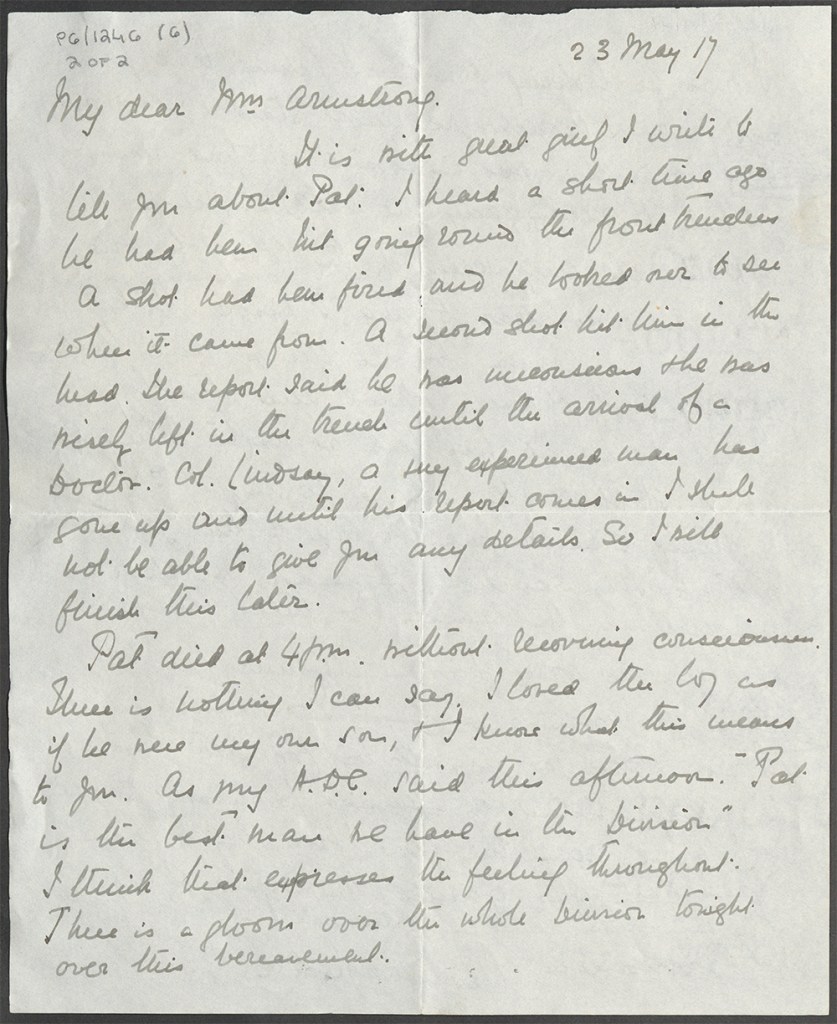
Upon opening the envelope a single sheet of paper is found, roughly A4 size. For the age of the letter, it is in remarkable condition. The paper has barely aged, and features handwriting on both sides of the sheet. The letter is structured into three paragraphs, with a clear beginning, middle and end. The writing is laid out very neatly, with words written straight in lines and is very well spaced. The text is written in the cursive, and we can assume that the letter was more than likely written in one sitting with the same pen, as the style of handwriting and the colour of the ink does not change throughout the entirety of the letter. While the letter is in great condition, the handwriting unfortunately can at times make some words difficult to read, owing in part to the flow of de Lisle’s writing. The only abbreviations used in the text are ADC, (aide-de-camp), and Col, (colonel). There is a balance between professionalism and empathy in his writing; this would be expected given his rank in the military and would be expected to conduct a certain sense of professionalism in his writing. The fact that this letter of condolence has been handwritten as opposed to having been composed on a typewriter shows that great thought and care has been put into its composition, and that both this letter, and Pat’s passing clearly meant as a great deal to de Lisle.
The second set of sources1) are two letters, both related to one another. They were originally written by same author, Charles Benjamin ‘Percy’ Wilson, who was a close friend of Pat’s and served in the same regiment as him. The letters are addressed to Irene ‘Reenie’ Wills, Pat’s fiancée. Dated 23 and 25 May respectively, the letters were written by Wilson to express his condolences to Irene and to comfort her at the loss of her fiancée, very shortly after the death of the latter. Interestingly, the two letters in question are copies of the originals; Irene hand copied the two that we see today. The originals meant quite a lot to her and copying them meant she would always have a copy of them nearby. Since the letters are copies, it is difficult to get a true appreciation of the emotion and depth that Wilson put into them, as we are not viewing them from the perspective in which he wrote.

The letters comprised of two sheets of paper. The bigger of the two is square in shape folded into two halves, about the size of what one would find in a small notebook. The other only makes up half of that size. This implies that they might have been written into a notebook and then removed afterwards. In total there are six sides with text on them. The pages have yellowed with age, and there are some blotches and stains throughout which can obscure some words. It is difficult to say what kind of stains are on the page. Perhaps they are just from the general age of the document, or maybe even a tear that fell from Irene’s eye. Written in pencil, and written while leaning heavily, Irene’s handwriting is easily legible and has lasted well on the aging paper. The colour of her writing changes halfway through her transcription of Percy’s second letter, suggesting that she transcribed it over two different sessions or simply just changed pencil. When transcribing, she made some spelling mistakes and corrected them by writing heavily over the error. This can be best seen on the second page of the second letter from Percy, where Irene writes over the ‘o’ in ‘yourself’, the ‘sci’ in consciousness, and the ‘hi’ in ‘him’. The paragraphs are clearly laid out, as are the lines, however there is a slight slant to the lines which is to be expected when writing on unlined paper, and this causes some words at the ends of lines to become bunched up and possibly difficult to read. Regarding Percy’s style of writing, his letters are much more personal in tone when compared to de Lisle’s, as his letters are not official letters of condolences. His tone is very caring, assuring Irene that Pat passed quickly, and gives advice on how to cope with his loss.
Please note all student submissions have been edited where necessary for accuracy and clarity.
- P6/1217(3[↩]

You must be logged in to post a comment.