by Adam Marnell, 2024/25 student
These letters serve as good examples of primary sources that allow for further research to be done on the Armstrong family and those associated with them, allowing for context to be given explaining how they would eventually lose their hold on Moyaliffe.
It is best to start analysing the primary sources by looking firstly at what we can learn about the life of the uniting figure found across the letters, William Maurice ‘Pat’ Armstrong. Born on 20 August 1889 at the family house in Chaffpool, Co. Sligo. He was only son and oldest of four children to Captain Marcus Beresford Armstrong (1889-1923) and Rosalie Cornelia Armstrong. He was named after his grandfather, Captain William Armstrong (1826-1889). He received his education at Eton where he would make a life-long friend in Charles Benjamin ‘Percy’ Wilson, and his nickname ‘Pat’, which he preferred to go by during his life. After schooling, like many in the aristocracy and the Armstrong family he carried on the tradition of serving in the military and attended Sandhurst Military College.
Following his military education at Sandhurst, he received a commission to serve with the 10th Royal Hussars (Prince of Wales Own). At age 21 he held the rank of second lieutenant.1 He would later serve with the Hussars in India and South Africa, taking part in military courses in the latter. H was engaged to Irene Wills. When war broke out in 1914, Pat found himself serving in France, and later in 1915 in Gallipoli, and took part in the disastrous campaigns at Suvla Bay and Camp Helles, serving as aide-de-camp to General Henry Beauvoir De Lisle at both fronts. De Lisle would get him transferred back to France. In 1916 he was awarded the Military Cross for gallantry, reported in the London Gazette.2 It was at the front in Arras on 23 May 1917, where he would meet his end, after having been shot by a German sniper.3 At the time of his death he held the rank of brigade major in the 29th Division. Pat had also been awarded a military cross for his actions during the war. His grave is in Arras, in Faubourg-d’Amiens, a cemetery managed by the Commonwealth Graves Commission.4
There are two individuals that we can learn about in the first letter. The recipient is Pat’s mother, Rosalie Cornelia Armstrong, who was born in 1868 to Maurice Cely Maude and Marie Elise Wehren. She had nine siblings, and her childhood home was Lenaghan Park in Co. Fermanagh. On the 11 April 1888, she married Marcus Beresford Armstrong in Enniskillen.5 The two would go on to have four children together, Pat and his three sisters. They lived in Marcus’ estate at Chaffpool, Sligo, until he inherited Moyaliffe House, Tipperary, from a distant relative. It was here that their marriage would become difficult, and while they never divorced, they would live separate lives. The 1911 Irish Census places only Marcus and three servants living in Moyaliffe castle.6 Prior to the war, Rosalie was living in Folkestone Kent, in a house called Clodagh. Pat left her the sum of £435, 8s and 4d in his will.7 She outlived her estranged husband, and she died in 1956, aged 88 in Folkestone. Marcus died in 1923.
The author of the letter was General Henry Beauvoir de Lisle, who was born on 27 July 1864 on Guernsey to Richard Francis Valpy de Lisle and C. E. de Lisle. He received his military education at Sandhurst and was commissioned with the Durham light infantry. His time in the army would have him see service in Egypt, India and South Africa. At the outbreak of war in 1914, he held the rank of general and oversaw the 2nd Cavalry Brigade as part of the expeditionary force in France. He would become close to Pat, in his letter referring to him as being like a son to him, and his death greatly saddened him. De Lisle would survive the war and retire from the military in 1926. He was noted for his skills at polo. A book written by him, titled Reminiscences of Sport and War, may be found in the Special Collections Archive at UL. De Lisle died on the 16 July 1955.
The recipient of the second set of letters was Irene Wills, Pat’s fiancée. She was born Evelyn Irene Hamilton Wills on the 30 May 1896. She was the daughter of Arthur James Hamilton Wills and Evelyn MacDonald Myburgh. Irene was engaged to Pat until his death in May 1917. Pat had given her the nickname of ‘Reenie’, and the two shared a love for horseback riding. Two years after his death, she would marry Wilfred Francis Herbert Watson (1892-1929) and they had a son, Colonel Sideny Watson (1920-1999). Following the death of her first husband, she married William Bagwell (1905-1979), and they had two more children, Hugh William Bagwell (1934-present) and Pamela Eve Irene Bagwell (1938-present). Irene and William lived in Clonmel, where she passed away on the 6 September 1965, and is buried in Marfield, Tipperary.
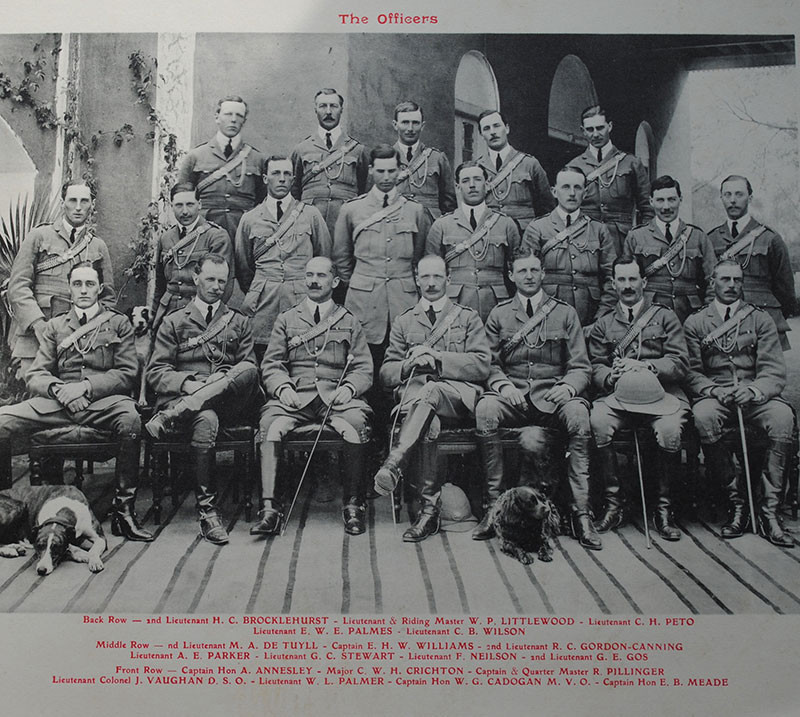
Captain Charles Wilson (far back right), 1910.
The author of the second set of letters, Charles Benjamin ‘Percy’ Wilson, was born in 1885 in Manchester, the son of Hubert Malcom Wilson and Francis M Wilsom. He had a brother, Leslie Wilson.8 Like Pat, he would receive an education at Eton, and would also receive a nickname, ‘Percy’, that he refers to himself with. In 1905 he earned a commission like Pat with the 10th Royal Hussars, in 1911 holding the rank of lieutenant.9 Percy married Janet Mackinson (1891-???) and had a son, John Malcolm Hamersly Wilson (1921-1942), who like his father served with the 10th Hussars, and died in Second World War in Libya. Percy set up a fund to support the men of the 10th in memory of his son. Percy earned a military cross for his actions during the war. Charles passed away on 9 August 1957 in Norfolk.
During the years before the First World War, Moyaliffe was a place that was more than just a home for the Armstrong family; it was steeped in history and social prestige. Yet the house would come to serve as an example as one of many that would not withstand the changes that the aftermath of First World War would bring to the Anglo-Irish aristocracy. Pat’s life was typical of a male heir to a family like his. It was expected that at least one member of an Anglo-Irish gentry family would serve in the military, as it was both a family tradition, and offered the prospects of a good career and social mobility and respect.10 In fact, the tradition of a duty of service in the military was so prevalent amongst the elite in Ireland that by 1901 14.4 percent of all officers in the British army were Irish born, which is quite significant when compared to the populations of other countries in the UK.11 He also followed in the spirit of his classmates and others who had gone before in Eton, feeling a sense of need to sign up in the effort.12 Pat’s death had a big impact on Irene, who now without her betrothed, was cast into a state of unknowing, her future gone. Her two marriages would have been typical to make sure she could be supported. Her life is one example of the many women in this social class had to learn to adapt and manoeuvre in a world where the stability of the big estates was crumbling, and to secure a future themselves by remarrying.13
Pat’s death shows how the effects that the war had on the tight knit communities that made up the aristocracy. Whole generations of men that had grown up together and socialised together were now wiped out, leaving empty spaces behind them. Both letters give the reader a sense of how much of a well-liked and respected figure Pat was, with De Lilse saying ‘there is a gloom over the whole division tonight over this bereavement’, and Percy saying, ‘everyone in the division liked him, and I must yet not heard a soul say an unkind thing about him’. The fact that De Lilse, a man of such high rank wrote as casually as he could suggests that Pat did mean a lot to him. The same can be said about Percy writing as soothingly as he could to try ease Irene’s pain. Without sons, fathers, brothers and friends to come home, there was a deep sense of loss felt in these upper-class communities.
Like so many of his class, Pat’s loss caused not only pain for his family, but the gradual loss of Moyaliffe castle from their hands. With no male heir, his father Marcus decided to bequeath the house to his second daughter, Jess, who had married Captain William Kemmis. This was no simple affair however, as the will would be contested in relation to the property. Jess and William had no children, and so left Moyaliffe to her niece, who sold it to the Land Commission. This sparked legal issues with the state, and although she managed to get back the castle, she lost ownership of the farmland. Prior to her passing in 1982, she left the estate to a distant relative in South Africa, Robert George Carew Armstrong.14 Robert would then leave it to his son Graham, who sold it to a prominent businessman from Thurles in 1999, finally separating the Armstrong connection to the property. It would go for sale in 2019 and 2024, priced at €837,00 and €1,620,000 respectively.15 For Rosalie, Pat’s death, combined with her estrangement from Marcus and her relocation to Folkestone, further shows the growing detachment of many of these families from their properties following the First World War. The death of her only son was not just a personal blow, but also marked the beginning of the end of the linking of the Armstrong family to Moyaliffe.
Please note all student submissions have been edited where necessary for accuracy and clarity.
- 1911 England Census 1911 England Census – AncestryLibrary.com[↩]
- London Gazette, 1 February 1916, Page 1337 | Supplement 29460, 1 February 1916 | London Gazette | The Gazette[↩]
- De Ruvigny’s Roll of Honour, 1914-1919, UK, De Ruvigny’s Roll of Honour, 1914-1919 – AncestryLibrary.com[↩]
- UK Commonwealth War Graves, 1914-1921 and 1939-1947, UK, Commonwealth War Graves, 1914-1921 and 1939-1947 – AncestryLibrary.com.[↩]
- Civil Marriage records Irish Genealogy[↩]
- 1911 Irish Census National Archives: Census of Ireland 1911[↩]
- Will of Pat Armstrong England & Wales, National Probate Calendar (Index of Wills and Administrations), 1858-1995 – AncestryLibrary.com[↩]
- 1891 England Census 1891 England Census – AncestryLibrary.com[↩]
- 1911 England Census 1911 England Census – AncestryLibrary.com[↩]
- Terence Dooley, Burning the Big House : The Story of the Irish Country House in a Time of War and Revolution. (New Haven:, 2022), pp. 41-3.[↩]
- David Fitzpatrick. “Ireland and the Great War.” Chapter. In The Cambridge History of Ireland, edited by Thomas Bartlett, 223–57. The Cambridge History of Ireland. Cambridge: Cambridge University Press, 2018, p. 237.[↩]
- Peter Parker, The Old Lie: The Great War and the Public-School Ethos, (London, 1997), pp.31-40.[↩]
- Susan R. Grayzel and Tammy M. Proctor, eds. Gender and the Great War, (Oxford, 2017), pp. 213-14.[↩]
- Tipperary Star, March 13 1982, Irish Newspaper Archives[↩]
- Property Prices Residential Property Price Register[↩]