
by Anna-Maria Hajba, Archivist
Join us on a journey from Calcutta to the Island of St Helena through the pages of a journal kept by Harriet Marshall between 9 January and 4 April 1847 on her way from Allahabad to County Tyrone. A weekly blog post series, running 10 January to 4 April 2025, presents transcriptions from her journal for the preceeding week.
Wednesday the 13th Rose early, dressed self & children,1 heard their lessons, but was too fidgetty [sic] to sit and write to dear Robert[.]2 I cannot make out his silence no Letters from him since the 2nd day of my arrival here, I had promised to call on the Watt’s3 & did not know how to get there, the distance being too great to be comfortable in a Palkie4 [sic], Captain Cavanagh5 very kindly volunteered to drive me there which I very joyfully accepted[.] when I got there, they still continued to be quite undecided as to whether they would go in the Alfred, Captain Henning6 having enraged Captain Watt by some extra charge, the disagreeable man[.] I tried to persuade them to still come to the Alfred. Mrs W. promised to let me know how it would be settled by this evening, from her silence I fear they have changed their plans[.] how provoking when I thought all was settled so pleasantly[.] I shall still hope for the best[.] when we came back the Kennedy’s7 were waiting for me, so off I went shopping, I wanted very little, how fatiguing it is to go out with people who do not know what they want and run from shop to shop as Mrs Gairdner8 did today.
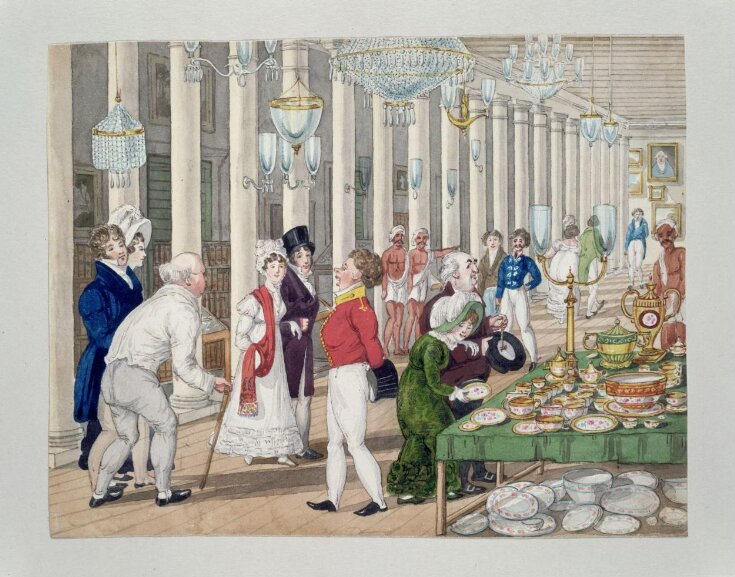
When I came back, the Cavanaghs had dined, I am very glad they did not wait for me as I was kept out so late (unwillingly) for the few things I now want[.] I do believe Box wallahs9 will be the best people to employ. I must close my Journal earlier tonight as I must [write] my dear Husband a long letter.
Thursday 14th Fourteen days more before we sail[.] I shall miss receiving and sending off letters very much when we get out to Sea, fancy for four weary long months, no prospect of hearing from Robert, this will be what I dread to think of most for I fancy myself to be a splendid sailor, & not at all nervous. I finished a long letter for Robert this morning and having done my duties I felt the time hang heavily, Colonel Lawrence10 called on me, his ship “The Gloriana” which was to have sailed on the 20th is now detained till the 27th[.] he sails at all events one day before us, I wonder who will be in England first!


I went to Miss Smith after our next visitor Mr Vincent left, the Cavanagh’s also went out visiting, In the Evening the Kennedy’s came for me they are now settled at Spence’s Hotel, the children were perfectly wild playing and making such a noise with Jimmy Kennedy,11 I am so glad they agree so well together, as they will play nicely on board ship.
I received 2 Letters, one from my dear Brother and the other from Dr Rowe, the latter about my European servant[.] I am getting anxious to see her, I only hope she is no fine Lady, we shall then agree very well together. I must write a long letter to Mamma now.
15th January 1847. I had the pleasure of receiving a nice long letter from dear Robert this morning[.] some news in it pained me much[.] I wrote in the heat of the moment rather a Lecture to my Mother.12 I enclosed it to Robert, so if he does not approve of it he can tear it up. I also had sincere pleasure in hearing from Mrs Watt that they have decided in going in the Alfred, I look forward with great pleasure to making her acquaintance for she is an interesting little woman. This last expression I have picked up from Captain Cavanagh, it is not a ladylike habit that of using certain expressions more emphatic than genteel. I sent the children over at 3 O.C. to Eliza, as I was going out to dine at the Bakers13 in the Fort[.]
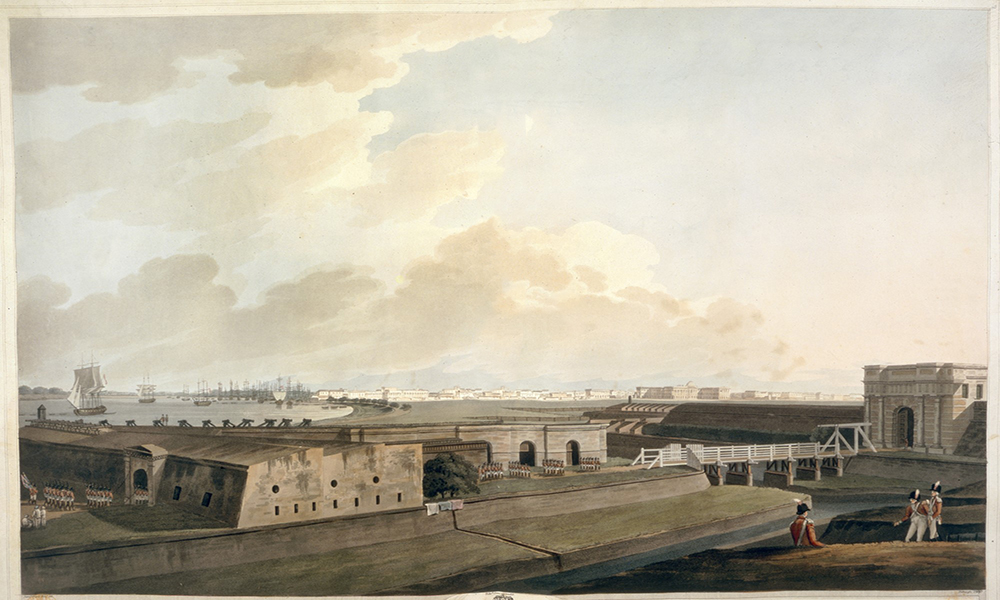
did not spend such a pleasant day as I had anticipated, the Quarters are not near so large as I had fancied them, and the poor young couple seemed to be obliged to shift as they best could having very little down here in their temporary Quarters of only a month[.] Mr Baker was called away to attend his mother & sisters, the 2 younger being obliged to go on board “The Monarch” which will sail early tomorrow morning, I wonder if poor Mrs Milner14 has gone[.] I never thought of this being the ship she was to go in[.] I gave her my address if she wanted any aid[.] how I wish my European servant may be like her. Tomorrow must be a busy day with me, I must go to call on Mrs Henning15 the wife of the Captain of our ship, and I should like to pay a visit to the Forbes if they will admit me early. I have not been able to get to Bed for the last 3 or 4 nights before 12 O.C. so tonight I must try to make up for lost time[.]
Saturday 16th January 1847. How tired I am tonight after been out shopping from 11 O.C. A.M. till 5 P.M. But the worst part of the work was that I had to wait till I was quite tired at Mrs Carberry’s a Milliner, till Mrs Col. Gardiner had made up her mind as to whether she would be very extravagant or not[.] she ought to have made up her mind beforehand as it was not the first time she had been in this shop, & had actually wished for the very things she bought in the end, for myself I do not admire Mrs Carberry & would not recommend her as a Milliner[.] one of her people was rather impertinent in the way she answered me, however she was the loser, I prefer Mrs Holloway who possesses a good taste in Millinery & all her people are extremely civil[.]

no one answers for the head of the establishment in the way they do at Mrs Carberry’s, I met Colonels Wake16 & Lawrence at the Exchange today, what a contrast between the two, the latter I saw first, we were mutually surprised to see each other, after saying a few words he saw we wished to be busy and bade us a good morning, the latter was so polite as to wish to hand us back to our carriage, and insisted upon waiting till he could do so, I allowed him to be a Martyr to his politeness till I saw what a fidget he was and had the humanity of saying it was useless to wait for a lady when she was in a shop, & begged of him not to delay there, on our account, it ought to be a warning to him in future. The Cavanagh’s dined in the evening as they had a small party a Revd Mr & Mrs Lamb17 & a sister of the Lady’s & Colonel Lawrence the former have all just arrived together last Mail, from England, the poor man has come out as a Missionary, what a sad difference he will find it to what he has been accustomed the specimens of Missionaries that I have seen do not really deserve the name, & yet this man has come out with the best and holiest motives, tho’ very mistaken ones I think as he has a family of 3 children[.]18

two they have left behind them, they will ill be able to afford them a gentlemanly education on their miserable pittance of £20 a month, why, their own expenses will come up to that & then if their children for want of a Parent’s guidance were in afterlife to turn out badly could they ever forgive themselves for having thrown away the privileges which they would have enjoyed of having them brought up under their own Eye, & which they now cast aside for an enthusiastic hope of uniting some few souls to Our great Master’s Fold[.] how much better for a Parent to look after those whom the Almighty has given him a natural charge of. A Bachelor or a man who has no family would be the best to come out to this benighted Country as a missionary. These Lamb’s asked me about a Piano & talked about a carriage which grieved me to hear knowing as I do how poor they will be[.] they sound like children with a new Plaything. I am unable to sit up much tonight as I am very tired.
Harriet’s journal has been digitised and is available to read in full on the UL Digital Library.
- Harriet’s children, Robert and Harriett Marshall.[↩]
- Harriet’s husband, Dr Robert George Marshall (1813-1857), an army surgeon.[↩]
- Captain Edward Watt (c. 1802-1864) of the 6th Bengal Light Dragoons and his wife Elizabeth née Worsley.[↩]
- Palki, a sedan chair carried by four bearers; also called a palanquin or palankeen.[↩]
- Captain William Orfeur Cavenagh (1820-1891).[↩]
- Commander Alexander Henning (c. 1792-1871), captain of The Alfred.[↩]
- Captain James Don Kennedy (1806-1898) and his wife Eliza Madelina née Turner (1820-1890).[↩]
- Jane Gairdner née Wishart (1822-1894), wife of Major General William John Gairdner (1789-1861) of the Bengal Infantry.[↩]
- In Mrs Marshall’s time boxwallahs (from the Hindi word bakswālā) were itinerant salesmen; it is now a derogatory term.[↩]
- Probably Colonel Henry Montgomery Lawrence (1806-1857), an English soldier and administrator, who played a key role in the consolidation of British rule in the Punjab region. He was knighted in England in 1848 while on home leave.[↩]
- James Edward (‘Jimmy’) Kennedy (1841-1865), eldest child of Captain James Don Kennedy and Eliza Madelina Kennedy née Turner (1820-1890).[↩]
- Harriet Maria née Johnstone.[↩]
- Lieutenant William Thurlow Baker (1824-1900), aide-de-camp to General William Vincent (1781-1859); and his wife Elizabeth Baker née Vincent (1822-1912), daughter of General William Vincent.[↩]
- Harriet’s hired servant on her journey from Allahabad to Calcutta.[↩]
- Melina Henning née Smith.[↩]
- Probably Major William Henry Wake of the 44th Bengal Native Infantry.[↩]
- The Reverend Richard Martindell Lamb (1809-1857) and his wife Charlotte Ann née Rands (1817-1896).[↩]
- Eleanor Marcia Lamb (1843-1932), Charlotte Mary Lamb (1844-1935) and William George Lamb (1845-1850).[↩]

You must be logged in to post a comment.