

The post below was written before the completion of the Bolton Library cataloguing project. Follow along to see what’s next for the Bolton Library collection.
by Olivia Lardner, Bolton Cataloguer
 Letter-writing has largely fallen out of favour in the 21st century, but here in Epistolarvm (Basel : Hieronymous Froben and Nicolaus Episcopius, 1539) we find the epistolary endeavours of two popes and an influential scholar in 16th century Italy in a substantial 700+ p tome.
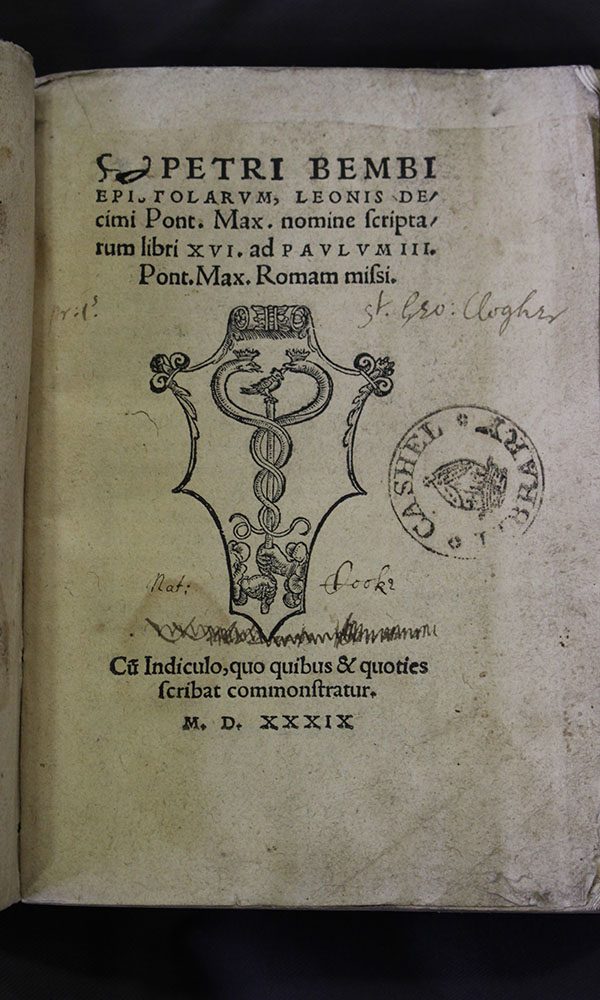
Pietro Bembo (1470–1547) – a key figure in the Italian language question1 and promoter of the Tuscan language of Petrarch and Boccaccio2 – and popes Leo X (1475–1521) and Paul III (1468–1549) are not our focus today, however. Something far more specific to Bolton Library C.10.3 merits our attention.
Parchment binding
We have been speaking at length in this blog about the waste fragments uncovered thus far in the Bolton Library,3 but until now said waste has been inside the items, either under or acting as pastedowns,4 or used for the backing and strengthening of spines. Here, however, we have waste which is front and centre: it is the binding itself.
What is believed to be a contemporary binding of parchment covers this item, with tawed leather thongs used around the spine and as ties at its foredges.5


What is clear is the repurposed nature of this parchment: it has been recycled from an original purpose as reading material. Look at the wide, clean margin off-centre here, separating two areas of manuscript6 text:
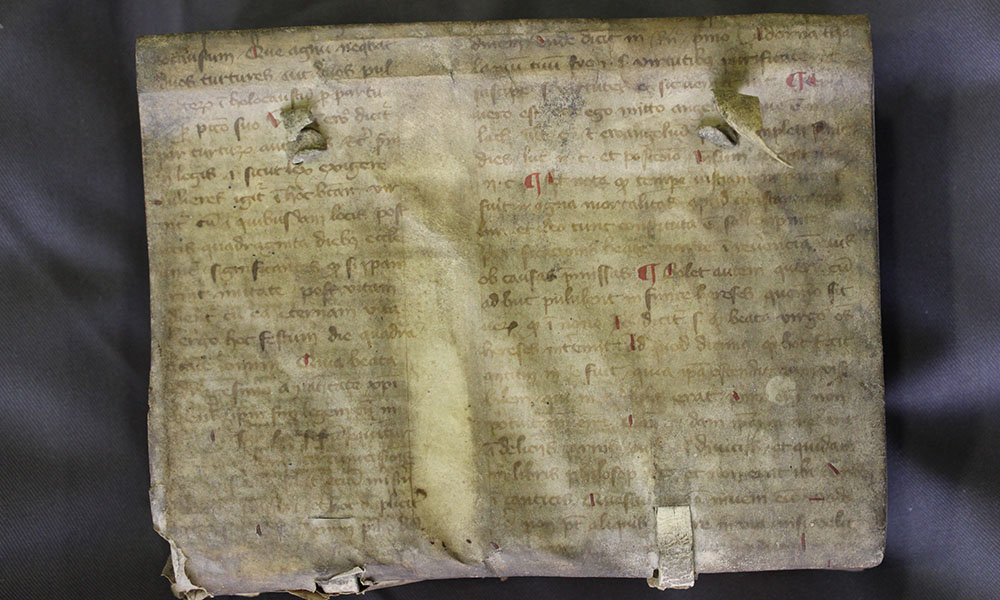
A manuscript has been discarded and disassembled, to be resurrected here by C.10.3’s bookbinder as a cover for this volume of letters.
Rationale divinorum officiorum
Readers of this blog should be aware that the reading of manuscripts is not the forté of this cataloguer, but initial investigations of text legible here point to it being a manuscript version of the De purificatione Sanctae Mariae sermon. Many individuals have sermonised on the purification of the Blessed Virgin Mary, or the feast of Candlemas, including SS. Bernard of Clairvaux and François de Sales.7
The text here however is a match8 to that appearing in Rationale divinorum officiorum by Guillame Durand (approx. 1230–1296) – see Bolton Library B.18.22 for a 1612 print edition of this text.
14th century script?
The script is another line of investigation – disclaimer above applies here also – with an inclination towards English cursive script of the 14th century, a script used for the production of both documents and books of medium quality, and here lacking the stylistic extravagances9 of its initial appearance in the 13th century.10 See the looped ascenders for the letters ‘d’, ’b’ and l’, the recognisable letter ‘t’, and the simple horizontal abbreviation bars. Note also the letter ‘s’ in a final position, e.g.: line 2 ‘turtures’, which looks almost like an incomplete letter ‘B’.
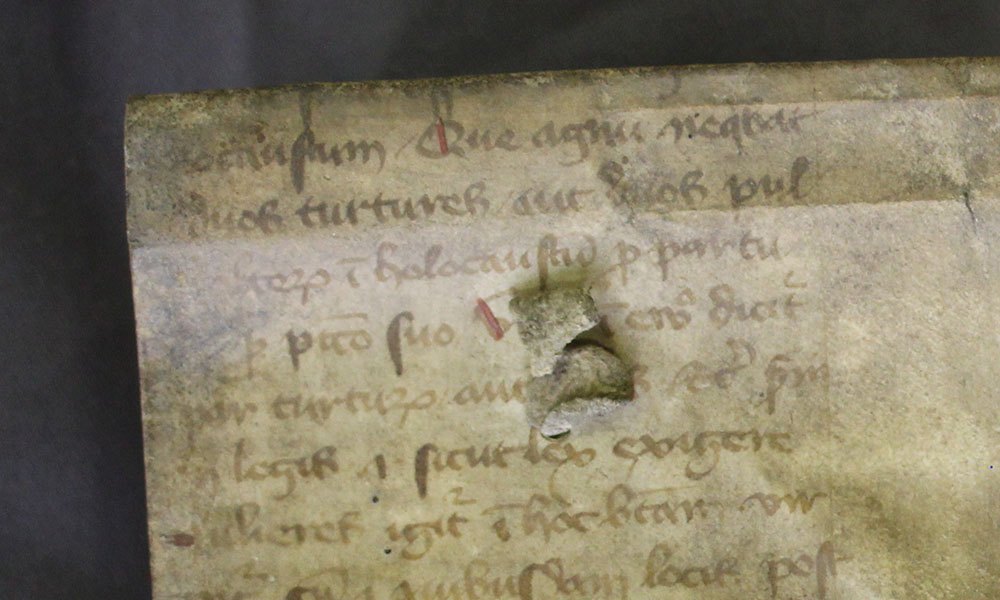
The repurposing of used parchment as book covers can also be seen on Bolton Library G.8.33, the 1580 Paris edition of Livy’s Ab urbe condita.


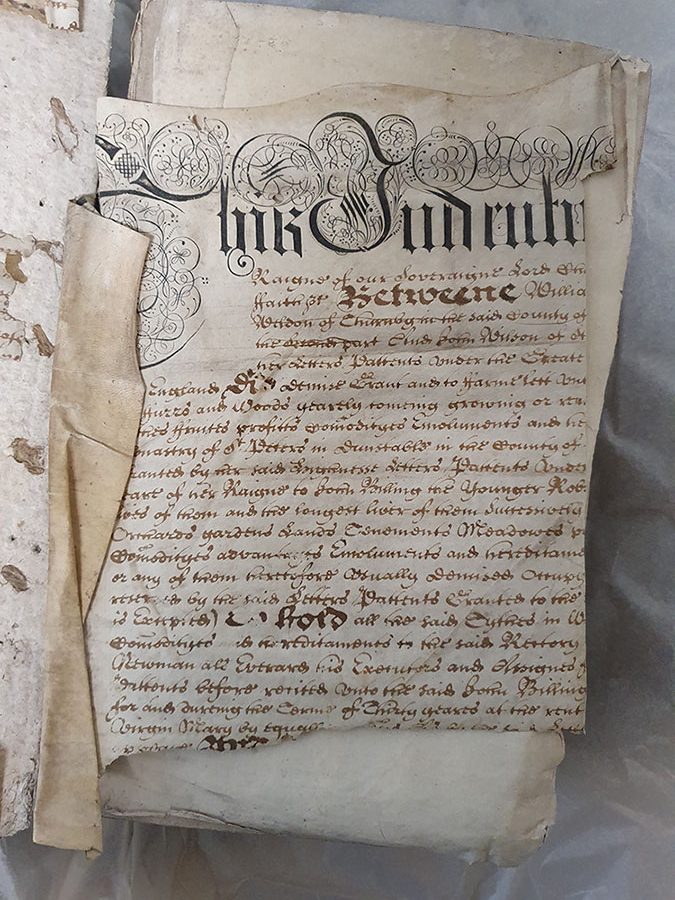
We find used parchment again employed as binding material in Bolton Library E.3.21. An English indenture has been scrapped and reversed for use here – one with a beautifully ornate opening ‘T’ initial extending down into fifth line of text – as a now badly damaged cover for a 17th century mathematical volume.
Pushing known boundaries
The Bolton Library is the result of the collecting activities of two Irishmen collecting across the island of Ireland. As a result, the content, patterns and fashions present in the collection are very much those of western Europe, with quite a large portion of the collection originating in England.11 N.R. Ker12 noted that the use of manuscript waste by bookbinders in England was largely a 16th century phenomenon, peaking in Oxford 1520-1570, plus decades either side, in Cambridge 1520-1570, but rarely employed by London bookbinders, and not after 1540. In Bolton Library E.3.7, however, we find five strips of manuscript waste on parchment being used in the binding covering a 1672 publication! This author of course acknowledges that the binding here may not be English, but in recognition of the fact that there could be very little lag in bookbinding trends across Europe, as well as querying the availability of manuscript waste so close to the turn of the 18th century, the use of it here is certainly bucking established parameters.

- See Bolton Library H.15.17 in Fragments of the Whole.[↩]
- Celenza, C. S. (2017). The intellectual world of the Italian Renaissance: language, philosophy, and the search for meaning. Cambridge University Press, p. 384-, available here.[↩]
- Read more in our Bolted On thread.[↩]
- Leaves, usually blank, pasted inside to front and rear covers.[↩]
- The front edge of textblock/ binding, directly opposite its spine.[↩]
- Written by hand.[↩]
- Ellington, D. (1995). ‘Impassioned mother or passive icon: the Virgin’s role in late medieval and early modern passion sermons’, Renaissance quarterly, 48(2), pp. 227-261, available here.[↩]
- Durand, G. (1775). Prochiron, vulgo rationale divinorum officiorum: opus iam recens diligenti fidelique opera catigatum, adnotationibus illustratum, et ad amussim perpolitum; ad haec summa rerum et vocum capita nunc primum adiecta, cum indice duplici. Madrid: Blasii Roman, pp. 400-403.[↩]
- View these extravagances in Bolted On #2.[↩]
- Brown, M. (Michelle P. (1990). A guide to western historical scripts from antiquity to 1600. London: British Library. Find it here.[↩]
- Correct as of Nov. 2023, nearly 52% of the collection originates from printing houses in London alone. This is followed at some distance by Dublin with just over 7% of the collection. Throw in the remaining print centres on these islands and 64% of the overall collection originates in the British Isles.[↩]
- Ker, N.R. (2004). Fragments of medieval manuscripts used as pastedowns in Oxford bindings : with a survey of Oxford binding, c. 1515-1620. Oxford: Oxford Bibliographic Society. Find it here.[↩]

You must be logged in to post a comment.