

by Olivia Lardner, Bolton Cataloguer
 hen dealing with material from the Bolton Library, a collection which has endured its fair share of loss and damage, we as cataloguers must weigh what remains – sometimes just fragments of the original – against the potential intellectual value which these fragments may yet hold.
In the case of Bolton Library D.7.26, a quite incomplete copy of Scriptorum theologicorum Heidelbergensium (Amsterdam : Jan Jansson, 1646) by Heinrich Alting (1583–1644), the copious annotations and insertions therein must hold a value of their own.
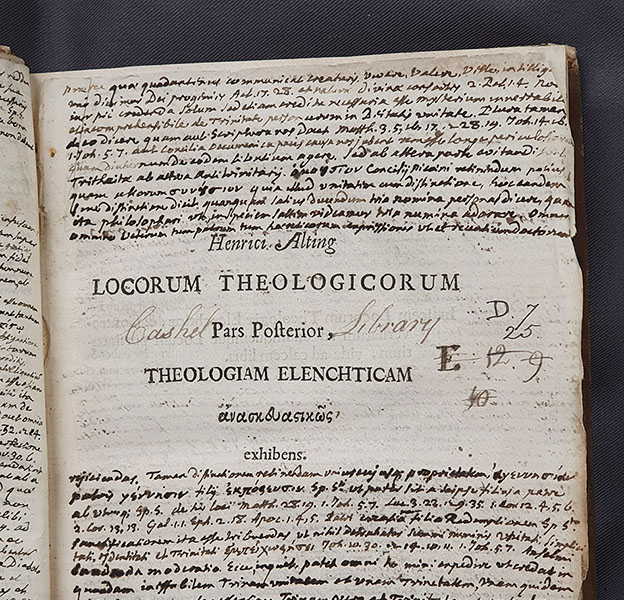
Why does this item, a work on the Heidelberg Catechism,1 merit such assiduous grangerization? For this is an extra-illustrated2 copy, with copiously compiled [contemporary?] insertions front and rear, along with heavy annotating throughout its textblock.


A tattered binding
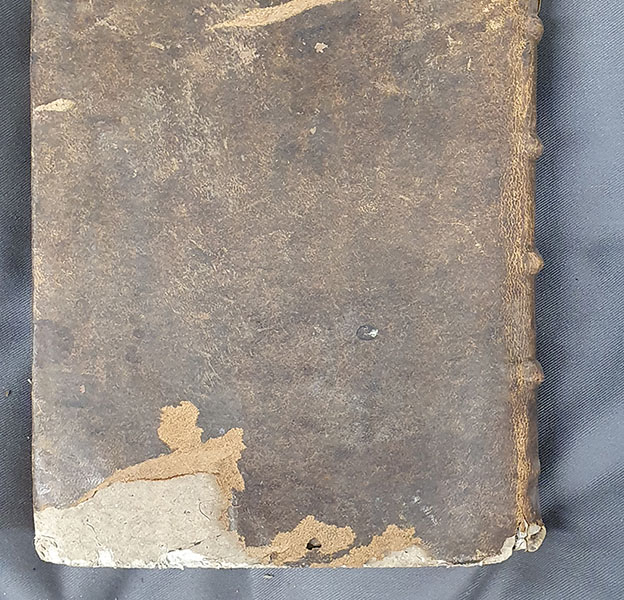
All to page 254 of volume one is wanting in the Bolton Library copy. Its binding may hold potential clues as to the partial state of this copy: its mottled leather binding – it is difficult to discern given its scuffed and poor condition whether the leather is sheepskin or another – bears extensive damage, e.g.: much of the leather on its rear cover is wanting. The author may wax lyrical on the bookbindings of the Bolton Library here in this blog, but the primary function of any binding is to protect the volume inside. When this barrier fails, loss of and damage to the textblock are sadly inevitable.
Proteo militare (Naples, 1595)
Loss of text, whether deliberate or otherwise, is not uncommon when dealing with early printed material. Take for example the missing leaves from Bolton Library H.15.17, a late 16th century work on a mathematical instrument by Bartolomeo Crescentio Romano, printed in Naples.
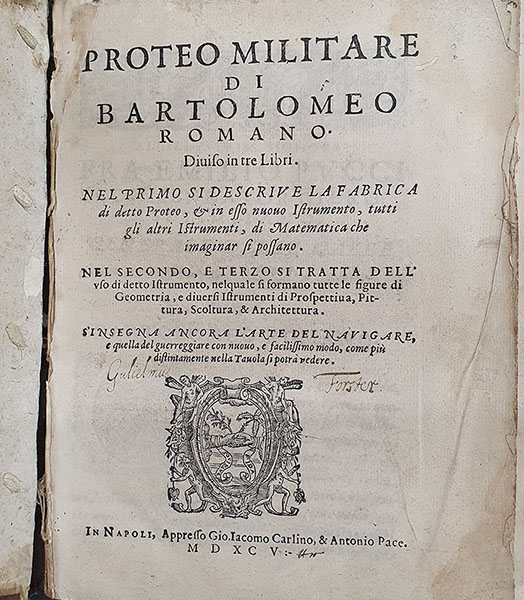
pp 129-134 of Proteo militare (Naples : Giovanni Giacomo Carlino & Antonio Pace, 1595), detailing the declination of the sun,3 have been harshly removed. Why? Was the text thereon deemed subversive, unorthodox, heretical, or just incorrect?


Crescentio was a typically energetic Renaissance man: hydrographer, cartographer, plumber, mathematician, naval engineer, writer, and captain of the galley in the papal navy.4 He was the author of two treatises, and here in Bolton Library H.15.17 we find his own invention described and illustrated across three books, detailing first its construction and then its myriad uses.


In evidence in this tome is the rise in popularity of the vernacular language, the author opting to use Italian here rather than the lingua franca of the sciences, Latin.
The work is dedicated to Fra Emilio Pucci, a colleague in the papal navy.
De origine ac progressu schismatis Anglicani (Rheims, 1585)
Sometimes, removed/ lost sections have been replaced, such as the curious and very neat replacement of gatherings5 in Bolton Library B.19.23, a history of the Reformation in England initiated by the ill-fated Catholic priest Nicholas Sander (1530–1581).
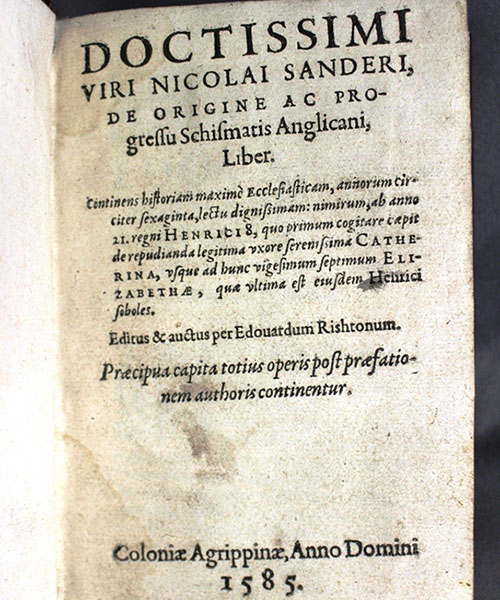
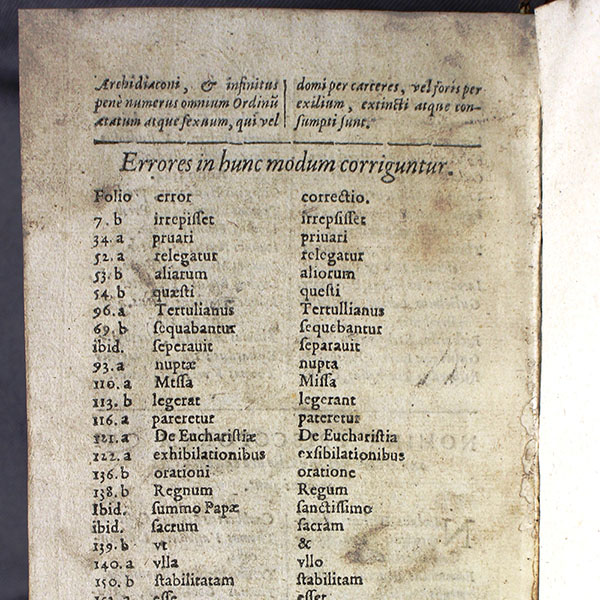
In De origine ac progressu schismatis Anglicani (Rheims : Jean de Foigny, 1585) gatherings A-B have been removed and replaced with manuscript6 insertions.


Has the original text been reproduced word for word, or has it been altered? A good test would be to see if its errors, as detailed below, have been faithfully transcribed or corrected:
Nicholas Sander (1530–1581)
Sander had a Munster connection: he led an ill-advised proselytizing expedition to Ireland in the late 1570s and died on the run somewhere in province in 1581.7 This volume was completed upon his death by another English Catholic priest, Edward Rishton (1550–1586).
The work was intended as a counterpoint to John Foxe’s Book of Martyrs – see Bolton Library E.2.1-3 – and went on to become a bestseller.8
Principal navigations expurgated
Elizabeth I hampered the printing in its entirety of another item in the collection, this time the lauding of English ‘traffiques’ in Bolton Library M.3.16.

In this issue (London, 1599), no mention is made on the title page of the “victorie atchieued at the citie of Cadiz, 1598”. The account of the voyage to Cadiz was suppressed by order of Elizabeth I after the disgrace of her erstwhile favourite Robert Devereux, Earl of Essex (1565-1601). The section is here supplied in manuscript on paper in a neat hand, and has been copied (pp 607-620) from the 1720 edition.


Bolton Library Ms 8
Bolton Library Ms 8 is a “short view of the state of Ireland from the yeare 1640 to the yeare 1652” written on paper in a cursive 17th century hand. Ff 3-4 are cancels in a different hand: why were they cancelled? What did the originals contain? The printed version, entitled History of the rebellion and civil wars in Ireland (Dublin : Patrick Dugan, [1720]) – see Bolton Library H.6.6 – may hold the answers.
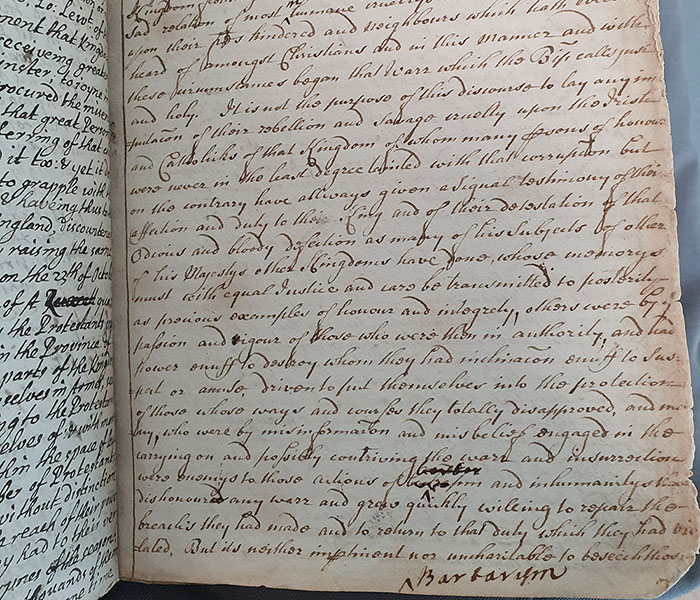
A further question, and one which could pertain to any and all of the preceding examples: who grangerized/ expurgated/ sought to restore these volumes? One for the researchers among you!

- Find another copy of this catechism here.[↩]
- Also known as grangerization; the inclusion of material by binder/ owner such as blank leaves, illustrations etc., not part of the original publication.[↩]
- Available here.[↩]
- CERL Thesaurus, CERL.[↩]
- Sheets printed and then folded for binding, e.g.: an octavo gathering is one printed sheet folded three times, giving rise to 8 leaves or 16 pages.[↩]
- Written by hand.[↩]
- Sutton, B. (1921). ‘Nicholas Sanders. Controversialist-historian (1530-1581)’, The Irish monthly, 49(582), pp. 504-506. Available here.[↩]
- Reutcke, C. That Romish fable framer: Nicholas Sander’s Schismatis anglicani. Available here.[↩]

You must be logged in to post a comment.