

by Liam Hayes, BA History Student
Within the Ballingal and Travers Collection, a haunting letter is found, an eighty-word letter, written in bold, clear capital letters. This concise yet powerful message was a death threat, dated 14 April 1918, addressed to Robert Rennie Ballingal, the agent to the 4th Earl of Dunraven at Adare Manor in County Limerick (P69/2/1(2)). Its envelope marked as ‘important’ hints at the significance of its contents (P69/2/1(1)).
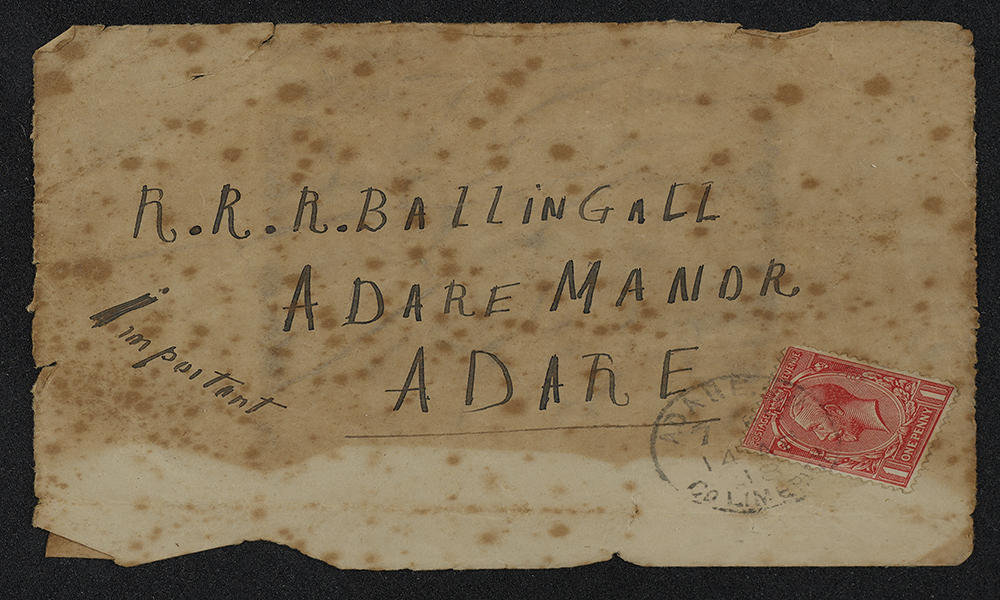
The anonymous letter, bearing no known author’s signature, adds an intriguing layer of mystery to its origins and message, along with the ‘COMAND COMMANDAINT’ signature. Typically, death threats do follow the same form with anonymity being a key factor or else by referencing a larger group that they are a part of to further intimidate the receiver. 1 This is certainly the case with this death threat.
The letter strikes a chord with its simplicity and legibility. The writer made no doubt in making certain that its content would be understood. The letter, inscribed on an aged, torn piece of paper and folded into quarters, shows the inherent dangers associated with the job of a land agent at the time.
Robert Rennie Ballingal and His Role
Robert Rennie Ballingal was born on 9 June 1867, in Argyllshire, Scotland. In 1894, he embarked on a role that would tie him to a pivotal moment in Ireland’s past. Appointed as the land agent to the 4th Earl of Dunraven at Adare Manor, Ballingal’s tenure extended for twenty-seven years until his retirement in 1921.
Beyond the administrative aspects of his role, he became a custodian of estates in a time of great unrest. Similar to the rest of Ireland, Limerick and Adare were no different in their involvement in the fight for independence. In East and Mid Limerick there were active Volunteer units who, around the time of the letter being written, had large units due to the fear of conscription.2 The leaders of these units were referred to as Company Commandants which is like that of the signature on this letter.

As the land agent at Adare Manor, Ballingal’s role extended beyond traditional estate management. It entailed overseeing the operation of a tobacco factory established on the estate by the 4th Earl of Dunraven in 1908. This diversification and innovation reflected the changing landscape of Irish country estates during that time. It is against this backdrop of evolving estates that the death threat, sent to Ballingal is placed.
The Death Threat to Robert Rennie Ballingal
Within the opening line of the letter, its intentions are clear. The writer claims to have full authority of their party to wipe Ballingal out. While it can not be said for certain it is highly likely that this is referring to either Sinn Féin or the volunteers of the area due to their heightened level of activity. Throughout the country, similar threats would have been made to landlords and agents. It was common to see land agents murdered for carrying out evictions amongst other reasons. 3 In another letter sent during the same time to Ballingal, there is a threat made to him which refers to evictions previously carried out. It is very plausible to believe this threat could have similar motives. The threat could also have originated from the 4th Earl of Dunraven’s strong belief in conscription in contrast to that of many of his tenants and the volunteers. 4 The precise cause for the letter remains unclear, although it is probable that it emerged due to one of the aforementioned factors if not both.
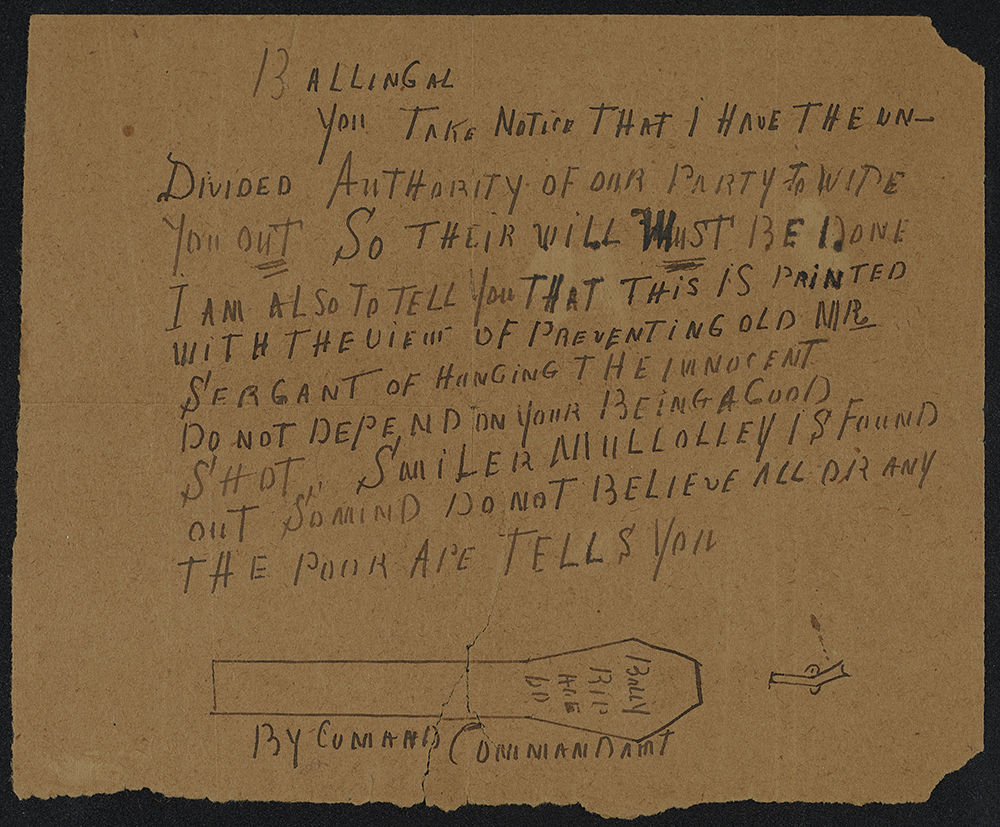
Regarding the mention of ‘Old Mr. Sergant’ in the letter, it appears to be a likely reference to the then-serving Sergeant of Adare during that period. This relation can be made as in May 1922 the District Inspector of Adare received a letter warning that he would be shot if he did not leave Adare. Unlike Ballingal the inspector fled to England on receipt of the letter. 5 It is important to note however that Ballingal did retire in 1921 and it is likely that the threats made against him would have influenced his decision to retire.
At the end of the letter, a childlike drawing of a coffin can be observed. Inscribed on the coffin is ‘BALLY RIP AGE 60’. One factor to highlight here is the fact that Ballingal was fifty years of age at the time. Therefore, either the writer was attempting to insult Ballingal, or else they were unaware of his correct age. The letter maintains a straightforward and direct tone from start to finish. The image at the end follows this same no-nonsense style.
Letter c. 1918–1920
The second letter sent to Ballingal calls for homes to be returned to tenants who had been evicted. While it is not a death threat, it still is strongly worded and provides us with a more informed view of the role the land agent played and his struggles around this time. It is plausible that both letters are linked. While this letter does not directly threaten death it states that ‘they are prepared to do the needful’. It is most likely that ‘they’ is a reference to the I.R.A and that the writer is a high figure within the Irish Republican movement as it is signed ‘The Captain’. This letter provides essential context to the situation in Adare around the time of the death threat.


The end for Ballingal
While Ballingal continued as a land agent until 1921, it is probable that his decision to retire from the role was influenced by both the threats against him and the significant impact of the Irish War of Independence, in which Limerick played a significant role. Although the death threat did not materialise into a direct attack, the escalating tensions during that period likely contributed to his return to his home in Argyllshire. The importance of this correspondence portrays the life of a land agent in Ireland in the early twentieth century.
- Stephen J. Morewitz, Death Threats and Violence New Research and Clinical Perspectives, (New York,2008), p. 15.[↩]
- Patrick Costello, Bureau of Military History 1913-21, (Bureau of Military History, W.S 973, No. S2267), p.3.[↩]
- Ciarán Reilly, The Irish land agent, 1830-60, The case of King’s County, (Dublin, 2014), p. 135.[↩]
- Michael V. Spillane, The 4th Earl of Dunraven, 1841–1926, (Limerick, 2003), p. 305.[↩]
- Seán William Gannon, ‘The inevitable conflict’ in Essays on The Civil War in County Limerick, (Limerick, 2022) p.111.[↩]

You must be logged in to post a comment.