

by Sophie McGrath, BA History Student
There are a variety of fascinating archive materials in the Armstrong collection at the University of Limerick, including personal diaries and documents from the first world war. One of these is a diary kept by Winona Rosalie ‘Jess’ Armstrong (1893 —1982). The diary of the clothes she bought and what they cost. (P6/1788(2))
The diary was one of 24 personal diaries Jess kept in her lifetime with many of her later diaries presumably destroyed by Jess herself. The diary is a soft back 28-page notebook part of the Eason’s copperleaf series of notebooks, with 8 years of entries totalling to 384 entries. It is handwritten with a thin black pen at the start then a darker inkier pen towards the end of the diary. The pages are thin with a brown hue to them that is likely due to the age of the dairy. The closed dimension of the diary is approximately 113mm x 179mm with a thin string holding the pages together.


The diary also has a separate note entirely that was from another diary torn out and put into this one This loose page was likely meant to be the opening page of the diary, the only writing on this page states ‘Rather amusing’- What my clothes cost, from 1911 onwards’. (P6/1788(1))
Jess Armstrong
Jess was born in Sligo, the third child of Captain Marcus and Rosalie Armstrong of Moyaliffe Castle in county Tipperary. The couple inherited the castle from Captain Edward Marcus Armstrong, a cousin of theirs. The ‘It’s a long way to Tipperary’ publication indicates that during the First World War Jess was living in Folkstone England with her mother and sisters. After the diary was written Jess later married captain Daryl Olphert Kemmis. The documentation and records in the archival collection show that there were succession issues with the Moyaliffe Stud, but the country house was passed down to Jess and her husband eventually.

White clothing
Elite women often used fashion to make a statement of wealth and showcase their fashionable taste. This can be seen through her buying a significant amount of white clothes throughout such as blouses and skirts. The essence of white clothing is a central theme such as a ‘white coming out dress’ located on the first page of the diary. (P6/1788(2)) White items clothing often signifies innocence, prosperity, and wealth within society in twentieth century both in Ireland and Britain.1

Fashionable society
Jess generally adheres to the most recent trends of the day such as using vibrant colours and draped Fabrics, and the use of lace.2 This can be noted as most of her clothing in the first half of her diary she bought items that were vibrant colour such as blue ribbons and pink evening dresses and green hats. The diary has several entries that demonstrate her upper status in society which includes the amount she spent on these clothes. This is evident in her multiple entries of ball gowns and fancy dresses as well as the amount she spent on these formal occasions that would have been held in big countries houses or halls.
Elite women also spent money on clothing for activities such as theatre this is displayed in one of the first entries through her buying ‘shoes for theatre’. Women of elite statues in this time would not have had jobs but activities such as theatre or singing as a pastime. Pastimes such as theatre for women demonstrated wealth, taste, and their social position in society.
Volunteer work
Many titled women, including Jess Armstrong, volunteered for the First World War effort. Members of this upper class voluntarily serving during the first world war would have been considered a noble sacrifice by society.3 The hospital items in this diary and photographs in the Armstrong collection indicate that Jess volunteered as a nurse during the first world war.
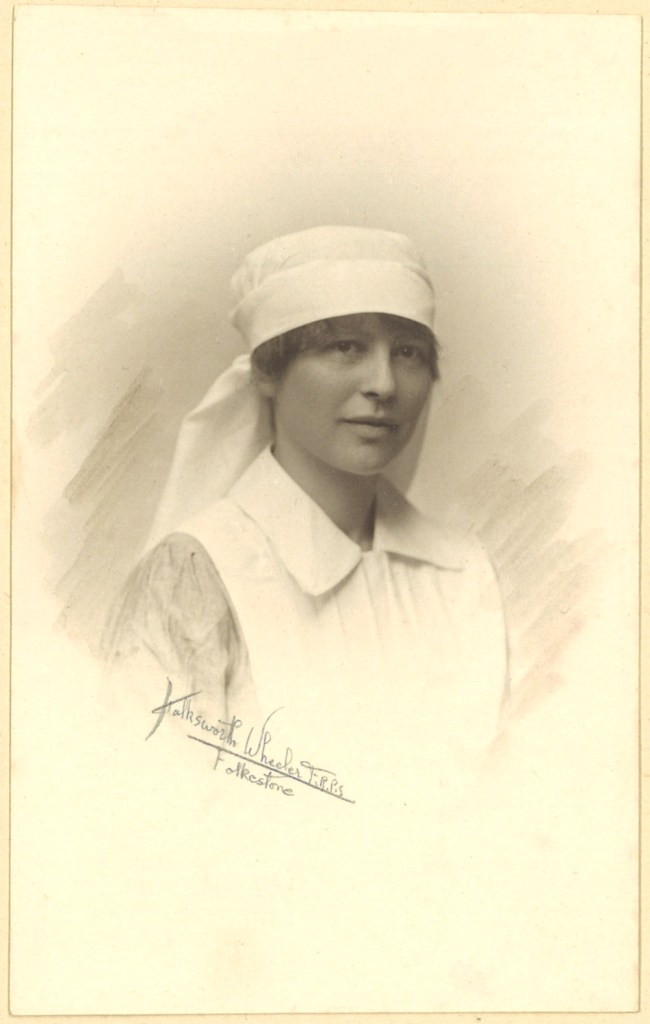
In the winter of 1915, a year into the first world war Jess was purchasing various elements of nursing outfits. Some examples out of the 11 entries of hospital items were grey shoes, cuffs, aprons, caps, and grey dresses all categorized as for the hospital. The photograph taken in Folkestone indicates she was a voluntary nurse in the England during the war.
Upcycling clothes
It is apparent in the year 1917 that Jess was doing a significant amount of upcycling to her clothing items in comparison to previous years. In the month of June, she dyed items such as coats and blouses into different colours. This indicates that she was preparing for winter as she specifies two coats being died in the summer months of June.
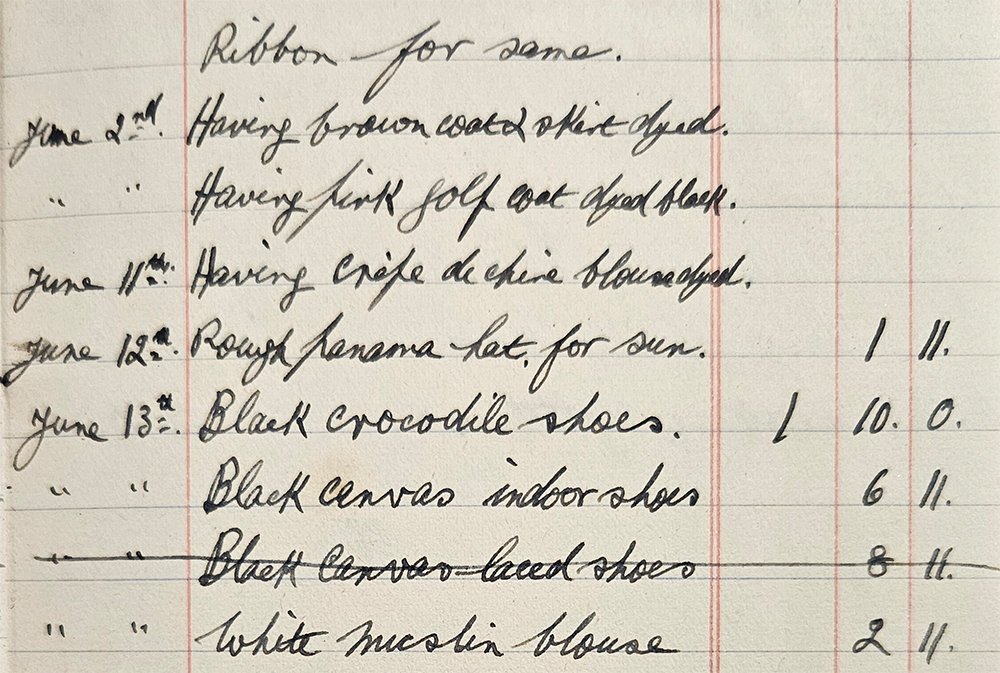
Along with the dying of clothing items she is also upcycling items like skirts such as getting them lengthened in the same year. The upcycling of clothes during this time may have indicated the difficulties of the importation of certain items of clothing such as winter coats during the war along with the inflation of certain items.
Personal diaries like this one add to the historical story of aristocratic women and their roles within society. In terms of personal inventory, the Armstrong archival collection and its journals contain a lot of information about this historical time as well as the personal lives and interests of the landed elite in the twentieth century. The items in this diary allow us to observe the numerous activities that elite women participated in, as well as the expense of those activities.
- Meave O’Riordan, ‘Leisure with a purpose: women and the entertaining practises of the Irish landed elite c.1860-1914’ in L. Land and W. Murphy, Leisure and the Irish in the nineteenth century, (Liverpool, 2012), p.220.[↩]
- ‘1910-1919’, Fashion history timeline, (https://fashionhistory.fitnyc.edu/1910-1919/) (20 Oct 2023[↩]
- Maeve O’Riordan, ‘Titled Women and Voluntary War Work in Ireland during the First World War: a case study of Ethel, Lady Inchiquin’ in Women’s history review, 27(2018), p.361.[↩]

You must be logged in to post a comment.