
by Anna-Maria Hajba, Archivist
Join us on a journey from Calcutta to the Island of St Helena through the pages of a journal kept by Harriet Marshall between 9 January and 4 April 1847 on her way from Allahabad to County Tyrone. A weekly blog post series, running 10 January to 4 April 2025, presents transcriptions from her journal for the preceding week.
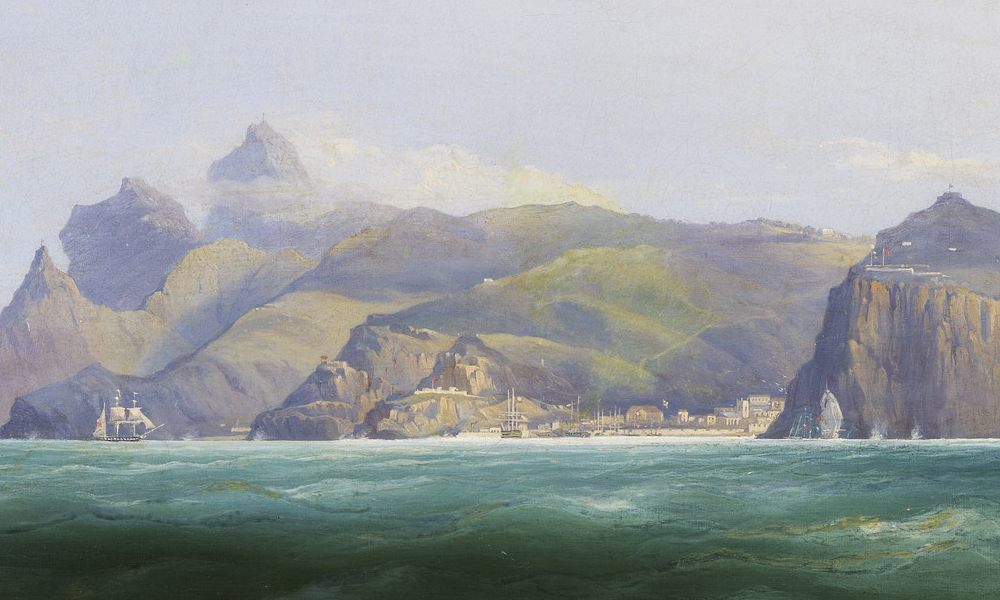
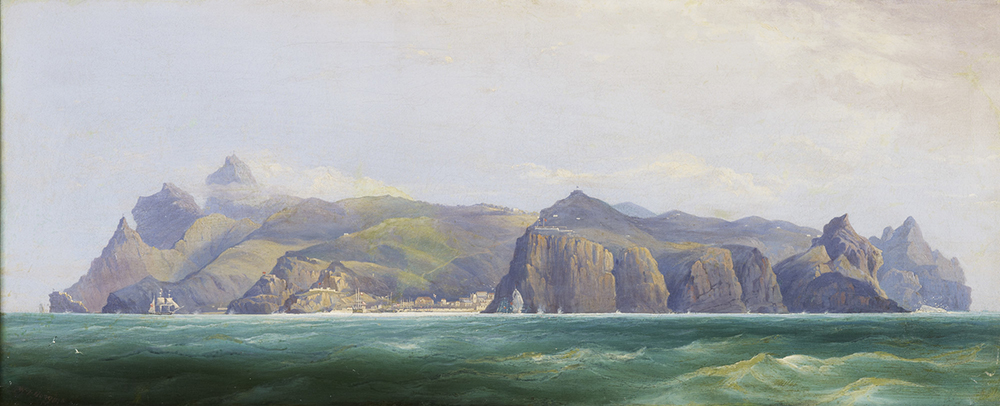
4th April 1847. Easter Sunday. Late on Tuesday night we anchored at St Helena, the instant we had done so, a Boat came alongside from the Steamer Pottinger I believe. The only news I really cared for then, I was fortunate enough to hear at once and that was whether we could send Letters by the Pottinger to India, she was going to put down some passengers at the Cape and then go to Point de Galle, from whence our Letters could be taken on to Calcutta by one of the Steamers from Suez to Calcutta. This was quite a god send[.] I sat up till 12 O.C. that night writing one letter to dear Robert,1 I then went to Bed thoroughly tired with excitement and watching the Island of St Helena as I had done for 5 hours & a half, we went on shore early on Wednesday[.]
on our way there, as the Steamer Pottinger was conveniently in our way there we went on board[.] we were certainly repaid for our trouble for she is splendidly & gorgeously fitted up, every thing one could wish for was there, even a beautiful Piano fitted in to the Bulwarks in the Public Saloon, the Tables could be cleared, & some 20 couple[s] stand up and dance to their hearts content, every thing had a light airy & elegant look & all in good keeping & taste, one peculiar circumstance to account for this light & airy look was that there were no cabins in the stern of the vessel, a flood of light passed in from the windows into the saloon[.] the cabins were arranged on either side small but elegantly fitted up, with every convenience for the most fastidious Lady, when we went up to the steamer, we left the children & servants in the little Boat in which we were going to shore, when we came back to it, I was grieved to find that the heaving of the Boat had made poor Georgy quite sea sick, this feeling soon left him for we were soon after on Terra firma again after being exactly 2 months at sea. I was rather disappointed but agreeably so to find that the landing place of which we had heard such fearful accounts was nothing but a step from the Boat to the shore[.] we had been told that the surf would be moving the Boat up & down at a fearful rate & that if we did not give a good jump on to the jetty when the surf raised the Boat, we should probably have to swim for our lives, hearing all this I was quite afraid about the children landing however it was only a step.
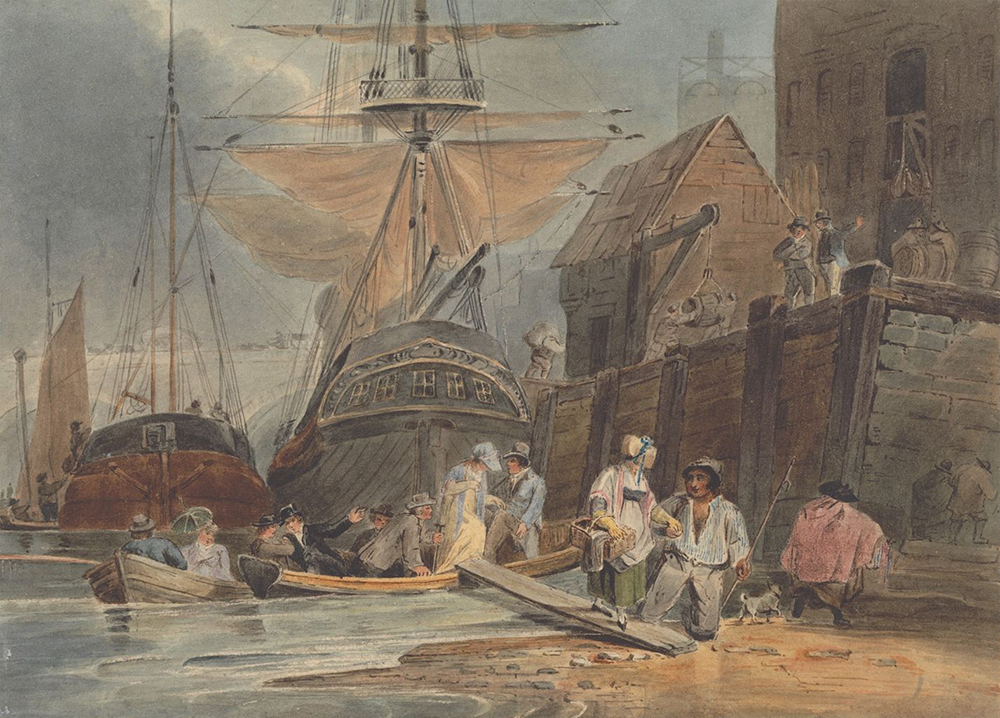
The landing place was a dirty one, & to improve it, it had been raining during the morning so we had to walk through the mire for a short distance, a carriage (such as it was) was in waiting for us, it had been sent by Major Rowcroft from the Hotel for us[.] this said Hotel was very near so we soon arrived. Breakfast was in a kind of way ready for us, for Major Rowcroft & Mr Ward had just finished theirs, I was very hungry as in the hope of getting fresh Butter & eggs on shore we had not taken any thing on board, I managed to get an egg & some fresh Butter & Bread, these last were indifferent. The Bread on board was far superior, it was decided that we should pay a visit to Plantation House and Longwood without delay, so as soon as the children were made comfortable, we set off 9 of us in two carriages, the Moule’s Mrs Faithful2 & Major Rowcroft in one the Kennedy’s3 Mr Ward Mr Oakes (one of the young gentlemen) & self in the other. It was very hot at times, winding round the Hills, one carriage had the Horses harnessed â la Tandem & a man at the head of each animal, some parts of the scenery was truly English, Mr Oakes gathered a quantity of Blackberries, from the road side, these, tho’ not very fine were very acceptable, the Pine fern & Oak Trees we were truly delighted to see once more, the scenery round Plantation House, where the Governor of the Island resides was beautiful[.]

we stopped at 2 Public Houses by the roadside for the fun of the thing[,] the gentlemen entered but did not bring back any intelligence of sufficient importance to induce us to alight[.] a few yards from the last Public House on the road to Longwood we were asked to enter a neat looking little cottage where we were plentifully regaled with Apricots, Peaches and Pears, it all seemed to me a dream, when we entered a Little Parlour where we sat and looked out upon the garden treading boarded flowers again reminded me so much of England that it appeared as if by magic I had been transported to Aunt Hodges’4 cottage at Cerne Abbas, we learnt from the ladies of the House that the Cottage had been tenanted by the Count & Countess Bertrand5 who were attached to the Emperor Napoleon suite, & who were with him in his last moments[.]

some Lilies were presented us which had been planted by the hand of the Countess[.] after we left this cottage on our way to Longwood the mountain road was very bad, & our own carriage[,] a very ricketty affair[,] was upset going over one of the deep ruts[,] the spring broken and all of us thrown headlong over each other, Major Kennedy & Mr Ward were the 2 up first & they tell me that Eliza was thrown furtherest [sic]. I was seated on the side that the carriage fell to, I fell partly on Mr Oakes & the wheel of the carriage upon me, when I was taken up, I all but fainted from the dreadful pain in my right shoulder & arm, I could not speak or move, & felt certain that it was broken[.] at last however I am thankful that it was not quite so bad & I escaped with a severe sprain & several bruises, Eliza had a most fearful thump on her head & a bruise on her leg, Mr Oakes hurt his foot & arm the other 2 escaped unhurt. It was most providential that the carriage did not upset to the other side as we should have been precipitated down some hundred feet[.] it was very lucky we had Mr Oakes with us for he mended or spliced (as he termed it) the broken spring very neatly & strongly[.] the other gentlemen did not understand how to do it, 2 carriages full of people from the ship “Sandford” passed us as we were all standing by the side of our carriage, we met them a short time afterwards at Longwood… (to be continued next week)
Harriet’s journal has been digitised and is available to read in full on the UL Digital Library.
- Harriet’s husband, Dr Robert George Marshall (1813-1857), an army surgeon.[↩]
- Louisa Sophia Faithfull née Wilson (1826-1858), widow of Lieutenant Henry Jacob Young Faithfull (1823-1846).[↩]
- Captain James Don Kennedy (1806-1898) and his wife Eliza Madelina Kennedy née Turner (1820-1890).[↩]
- Mary Hodges née Swayne (d. 1855), wife of John Hodges (d. 1837) of Cerne Abbas, Dorset.[↩]
- General Henry Gatien Bernard (1773-1844), who followed Napoleon into exile, and his wife Élisabeth Françoise ‘Fanny’ Bernard née Dillon (1785-1836).[↩]

You must be logged in to post a comment.