

by Anna-Maria Hajba, Archivist
Join us on a journey from Calcutta to the Island of St Helena through the pages of a journal kept by Harriet Marshall between 9 January and 4 April 1847 on her way from Allahabad to County Tyrone. A weekly blog post series, running 10 January to 4 April 2025, presents transcriptions from her journal for the preceding week.
8th March 1847. Monday. 5 Sundays have we spent on board, oh! if I could but hear from Robert1 I should feel so much happier, my arm is very much better.
As Mrs Faithfull2 & I were walking up & down last evening, we were very much surprised and amused by Mr Hill[’]s a very taciturn & shy mannered gentleman coming up & offering us his arm, he hardly ever speaks to a lady & was never known to have offered his arm to anyone before so when the rest of our fellow passengers saw him walking with us they could not believe that he had done the act voluntarily, this has caused quite a sensation among all[.] this does not happen every day & it is something after having been 5 weeks on board to create any new sensations. We have been going on so well that we are planning about we will do at St Helena, Captain Watt3 quite delighted us with the idea of a ride to visit the spot where once rested the bones of the great Napoleon, how delightful to ride again to feel a noble animal bounding away & to feel perfectly at my ease on its back knowing & feeling my own power, I can well enter into the feelings that the Honourable Mrs Norton has rendered imperishable by those beautiful lines supposed to be addressed by an Arab to his Horse that he was nearly selling to the French consul beginning thus “My beautiful my beautiful that stand’st meekly by with thy proudly arched & glossy neck and dark & fiery eye”[.]4 if these lines do not inspire one with enthusiasm for Horses nothing will!

9th March 1847. Tuesday. 11 months have elapsed & completed today since it pleased the Almighty to take our little one from us,5 now I wish I could have shewn 3 little treasures to my Parents in Ireland6 instead of only 2!
We had a very good wind all last night which died off during the forenoon[.] about 2 O.C. I went on deck again[.] the breeze has been freshening since, & is now blowing us on at a splendid rate, this day week we hope to be rounding the Cape. I have begun a pair of Baby’s socks for Mrs Watt’s7 expected little one, it is much easier work than I had imagined. Dr Welsh came & asked me to make a screen for a poor sailor who has the Op[h]thalmia, I begged a piece of green Gros de Naples8 from Mrs Berrill, & set to work knowing how much the man must be suffering from the want of such a thing.

14th March 1847. Sunday. Nearly a whole week has elapsed since I last wrote my journal. The weather is now really delightful[.] I can now sleep with a quilt over me, & the children9 wear their cold weather clothes with comfort. We were going at a good rate during the early part of this week, tho’ for the last 3 days we have hardly anything but calms & contrary winds[.] so provoking when we expected to have seen land today.
Another Death took place yesterday amongst the Invalids, the 4th since we embarked[.] what a melancholy idea it is that of a burial at sea particularly so to me if the prophecy of the old Dorsetshire Gypsey [sic] proves true. God’s will be done, we must all die tho’ one wish of my heart is to see my children happily provided for, all happens for the best, so come when it may, I pray Death may not come upon unawares.
I have been busy learning new kinds of work and reading, tho’ I cannot make out how I have allowed so many days to elapse without writing my journal. During the last week several quarrels have taken place, the Captain10 was called upon by Mrs Newhouse11 to speak to Lady Littler12 about the conduct of her children, somehow the rights of the story we have not been able to make out yet[.] the Kennedy’s13 are looked upon by Lady Littler as her enemies & she has cut them both[.] it seems so strange that Lady Littler should cut them, as hitherto they have been the best of friends[.] no quarrel either by words [—] or looks have taken place so why could the cut be given[.]
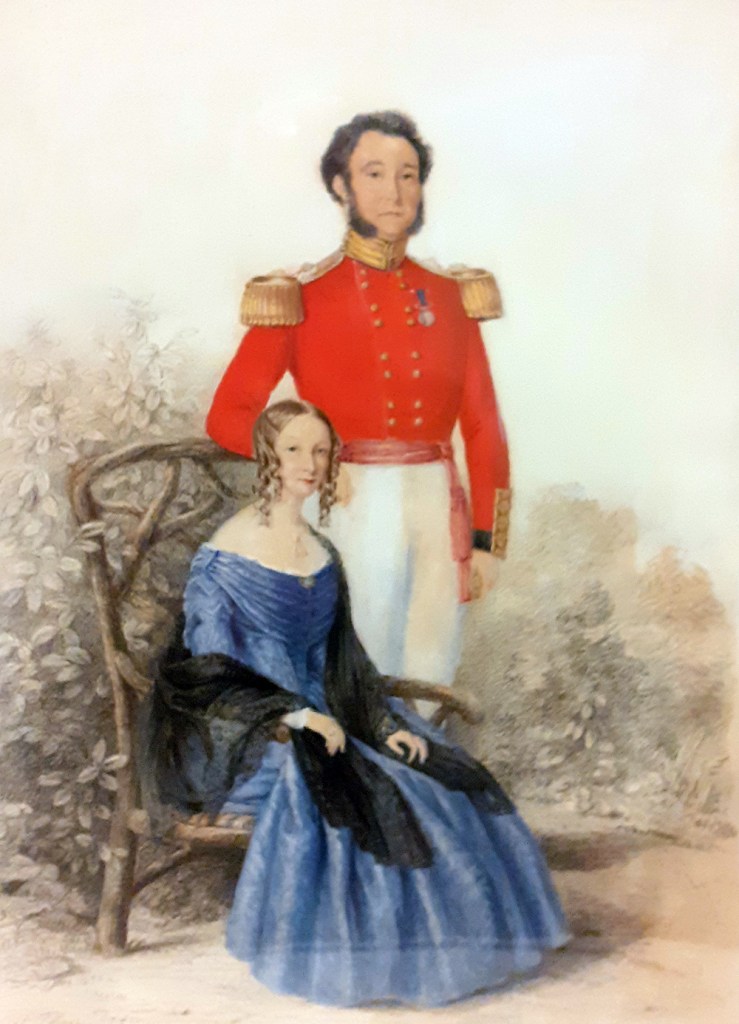
Lady L. treats Mrs Henning14 quite cooly [sic] I suppose because Captain H. took Mrs Newhouse’s part. This is childish behaviour on Lady Littler’s part. I must now give the substance of a quarrel between myself & Captain Watt at the Dinner Table yesterday. Mrs Bride was discussing the wholesomeness of Raisons [sic] for children with Mrs Consitte, & gave as her authority that the Doctor had forbidden them, Mrs Consitte muttered something about Doctors not knowing much of the affair, so I laughingly said “Don’t abuse the Doctors Mrs Consitte, as I am a Doctor’s wife” whereupon Captain Watt asked me if I knew how Doctors were classed[.] I said “no!” well he said they are a certain set of animals paid to give drugs, the proportions of which they know very little & added something else but my blood was tingling before he had finished, & I said “That just shows how ignorant the person was who had thus classed them”[.] Mrs Watt said oh fie! Edward you should not abuse Doctors before Mrs Marshall he said, I dare say you think your Husband the best & wisest of mankind[.] I said “of course I did”, [“]ah! if you could only make the world believe so too”[.] I had only time to say that I cared very little what the world thought or believed, so long as I was assured of my own feelings when the signal nod had been passed to leave the Table, a short while afterwards, Eliza’s woman came & told me that Captain Watt had sent me, his compliments & was standing in the steerage to speak to me, I went out he came forward & said “You are not angry are you with what I said about Doctors just now?”
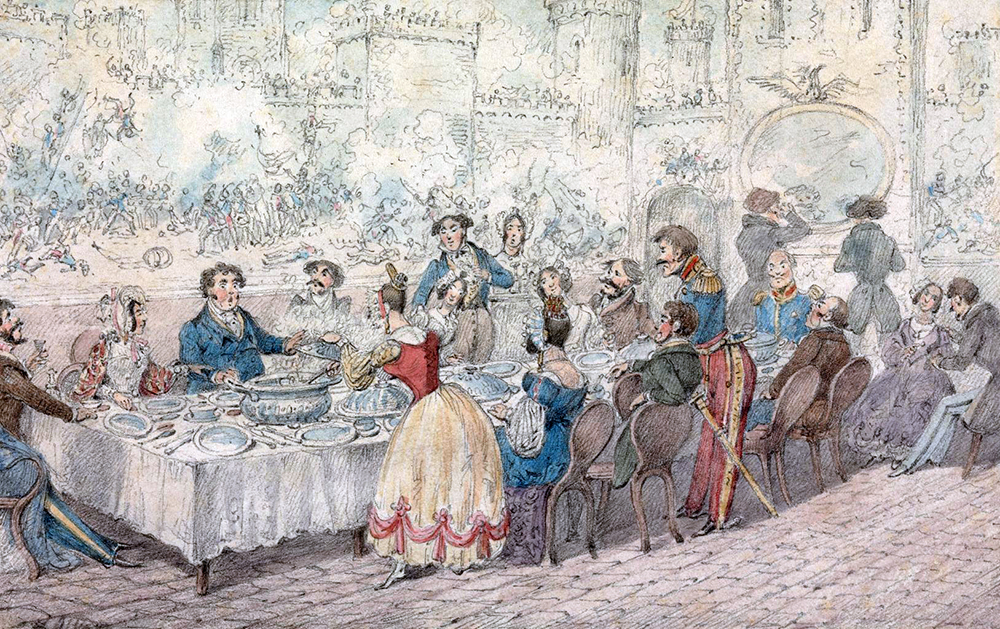
I replied that of course I was angry, as he ought to have remembered that I was the wife of one. “You are impertinent in talking to me so” he said, I replied that I considered him extremely so, & was walking away when he called out “I’ll say much worse tomorrow”[.] this I determined he should not have it in his power to do by cutting him[.] Mrs Watt & I laugh & talk as usual, but I will not speak to him, he takes too many liberties.
15th March 1847. Monday. This morning at Breakfast after bowing to several of the people, I very nearly caught myself bowing to Captain Watt, who burst out laughing, I looked at him steadily for a little time in amazement & then went on eating my Breakfast.
That unfortunate woman Mrs Newhouse is really very ill, I have sent Mrs Mason to her to do all in her power to help her, poor woman, the place is quite quiet now since she has been confined to her bed, she was always scolding & beating, & her children roaring.
We can now sit upon deck much more than we used to do, I go upstairs after Breakfast & sit enjoying the fresh breeze of the sea, the children playing around till the school master comes at ½ past 10 O.C. till 12 then Dinner after that up again on deck[.] I hope in a short time to see the children’s cheeks quite rosy, at present tho’ they are evidently getting fat.
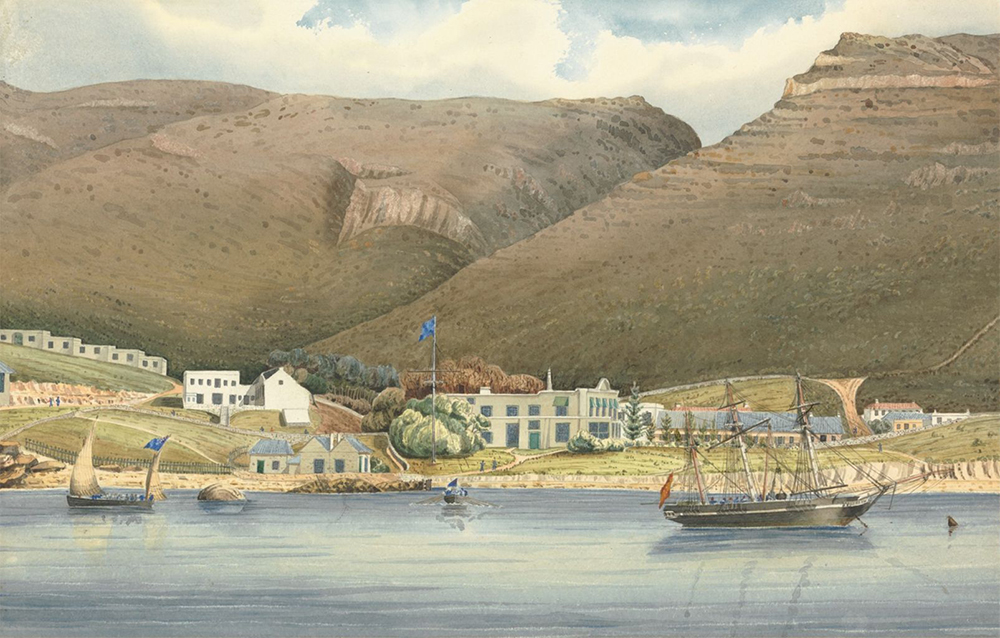
20th March 1847. Saturday[.] Another week has nearly elapsed since last I wrote. We have rounded the Cape in style and are now going as fast as we can to St Helena where we hope to arrive tomorrow week, how delightful treading once more on land after being for months at sea. We saw the Cape Mountains very distinctly[.] I was on the deck nearly the whole day, and have been there from after Breakfast till the Dressing Bell rang for dinner, I had such a colour when I appeared at the dinner table that everyone remarked me[.] the breeze is cold & bracing tho’ I cannot persuade the other Ladies to the same opinion, so I was the only Lady on deck[.] Eliza came up for a short time but she is inclined to be lazy. There is so little to write about, except the rate we have gone & the appearance of the sun [?] on the Chart that it appears uninteresting to me to note down in my journal particularly as Mr Meredith is keeping a small long book for me which will contain all that is interesting of our voyage. Thoughts I could fill a volume with but thought is quicker than Lightning so it is very difficult to keep a record of them, the one which is now continually pressing with me is the meeting with John15 or Joseph16 on my arrival, I am beginning to get nervous about what they will think of me & how they will meet me, and if they will be on the lookout for me.
Harriet’s journal has been digitised and is available to read in full on the UL Digital Library.
- Harriet’s husband, Dr Robert George Marshall (1813-1857), an army surgeon.[↩]
- Louisa Sophia Faithfull née Wilson (1826-1858), widow of Lieutenant Henry Jacob Young Faithfull (1823-1846).[↩]
- Captain Edward Watt (c. 1802-1864) of the 6th Bengal Light Dragoons.[↩]
- ‘Arab’s Farewell to His Horse’ by Caroline Norton (1808-77), first published in her collection of verse entitled The Undying One, and other Poems (London: Henry Colburn and Richard Bentley, 1830).[↩]
- Harriet’s third child, Mary Sophia Marshall (b. 26 November 1843), had died of whooping cough on 9 April 1846.[↩]
- She is referring to her parents-in-law, the Reverend Cornelius Henry Marshall (1770-1854), Rector of Killeshil, County Tyrone and Margaret née Brydge (1779-1847).[↩]
- Elizabeth Watt née Worsley, wife of Captain Edward Watt (c. 1802-1864) of the 6th Bengal Light Dragoons.[↩]
- A type of corded silk popular in the nineteenth century.[↩]
- Harriet’s son, Robert (‘Bobby’) George Swayne Marshall (1841-1915) and her daughter, Harriett (‘Harry’) Susan Marshall (1842-1926).[↩]
- Commander Alexander Henning (c. 1792-1871), captain of The Alfred.[↩]
- Bridget Newhouse née King (1815-1885), wife of sugar manufacturer George Newhouse (1795-1859).[↩]
- Helen Olympia Littler née Stewart (c. 1809-1855), daughter of Lieutenant-Colonel Henry Stewart and Louisa Colebrooke; and wife of Major-General Sir John Hunter Littler.[↩]
- Captain James Don Kennedy (1806-1898) and his wife Eliza Madelina Kennedy née Turner (1820-1890).[↩]
- Melina Henning née Smith, wife of Commander Alexander Henning (c. 1792-1871), captain of The Alfred.[↩]
- Harriet’s brother-in-law, the Reverend John Marshall (1802-1858), a Royal Navy chaplain.[↩]
- Harriet’s brother-in-law, the Reverend Joseph Marshall (1798-1875), Rector of Faughart, County Louth.[↩]

You must be logged in to post a comment.