
by Caoilinn Gleeson, 2024/25 student
This set of three letters, one written by blacksmith Con Duggan to Rochfort, another from Sullivan to Rochfort, and the final document from Rochfort to Duggan, is dated from the 5 March 1897 to 10 March 1897. Duggan’s initial letter expresses concern over the potential opening of a second forge in the Banteer estate, which he perceives as a direct threat to his livelihood after years of serving tenants faithfully. Rochfort sends this letter on to Sullivan to ask for his opinion on the matter, to which the rent warner responds that Duggan has been incapacitated due to a leg injury and has not been shoeing horses for those on the estate, leaving the community’s need for a forge unmet. Finally, Rochfort writes back to Duggan on an official document stating that he does not see a reason to advise Lord Lismore to intervene in Mary Deady’s decision to install the forge.

The two initial letters are quite small, about the size of my hand, with the writing changing from horizontal to vertical depending on the folds. Regarding the first, the paper appears aged, with visible creases from being folded, suggesting that it was meant to be carried or stored in an envelope. It shows signs of wear, likely due to the many hands that it passed though, with minor discoloration around the edges. The document features the handwriting of both Duggan and Rochfort, with the latter’s contribution being an annotation. The primary writing is in black ink and has a formal, cursive style. At the beginning of the letter, the writing is big but fairly even, with consistent slant and letter height. However, as it progresses it becomes larger and more broadly spaced – increasingly sloppy. The text turns vertically on the third fold and becomes cramped as Duggan tries to fit all the text onto one page. Many of the letters are smudged, suggesting that he was hurriedly writing this letter out of anger, especially in the last four lines. The secondary red ink text is in the hand of Rochfort and stands out from the main body added as an annotation. It has a more urgent style compared to his precise handwriting in the third letter, suggesting that he wrote it as rapidly as possible to send to Sullivan. He includes abbreviations and litters the main body of the letter with underlines and question marks, directing attention to specific issues within the document. A rectangular blue stamp on the top left reads ‘please return this to W. Rochfort, Cahir, Co. Tipp’ which suggests that the letter was part of a correspondence that needed tracking and return.
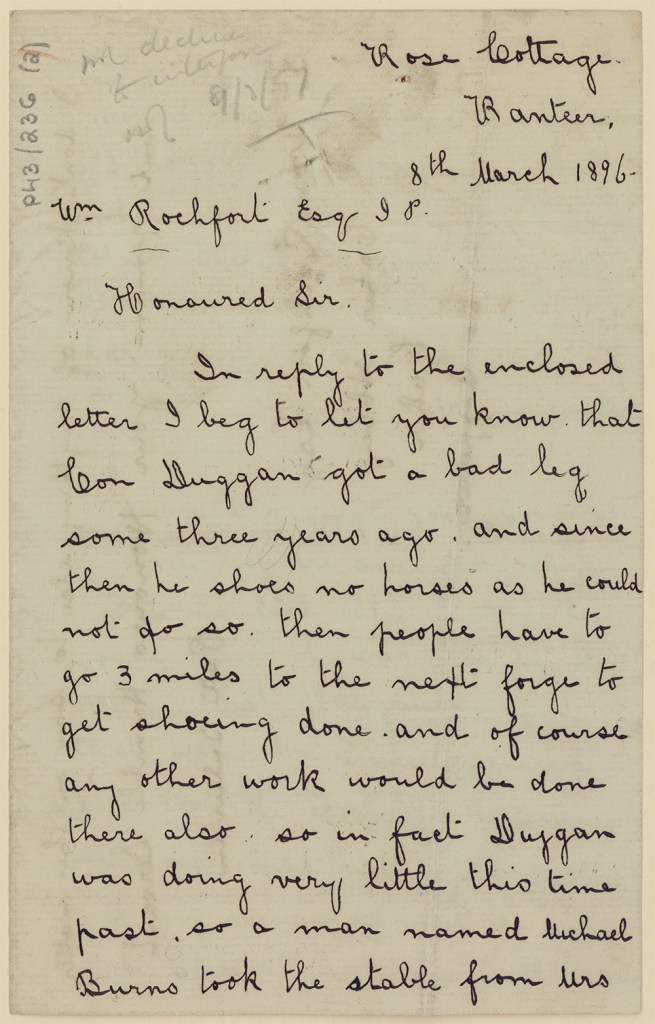
The second letter features the small, neat handwriting of Sullivan, much easier to transcribe than Duggan’s large scrawl. Like the first, it bares creases from folding and the writing changes from horizontal to vertical on the last section. The paper appears to be thinner than the first, with the black ink seeping through the parchment on either side. The last section of writing has left its imprint on the page opposite, indicating that the ink had not been given the time to fully dry before it was folded over. The ink is much darker and richer on Sullivan’s letter, compared to the faded ink of Duggan’s. This could either indicate that Sullivan leaned more heavily on his pen or used more expensive ink, or it could simply be that he took more time to write his piece compared to the hastiness of the blacksmith.
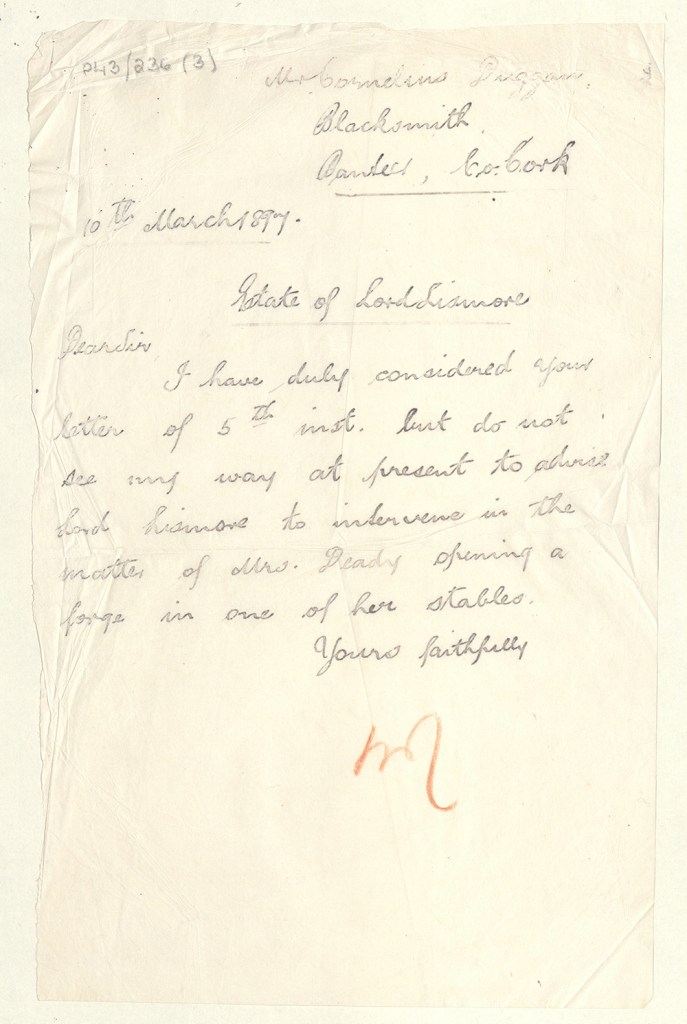
Finally, the third document is of a more official capacity and is written on a piece of parchment that is so thin it is almost transparent. The edges are rumpled and jagged on one side and many random creases run across the paper in all directions, suggesting that Duggan may have crumpled it up in anger after receiving it. Rochfort’s red signature is blunt on the page – giving the blacksmith a swirl of initials rather than the full signature he offered Sullivan – denoting that he may have promptly written the letter as if to dismiss the issue as quickly as possible.
Please note all student submissions have been edited where necessary for accuracy and clarity.

You must be logged in to post a comment.