
by Caoilinn Gleeson, 2024/25 student
The letters date to 1897, a period when the Irish land system was undergoing significant transformation. The Irish Land Acts, beginning in the 1870s and continuing into the early twentieth century, aimed to alleviate the traditional feudal relationship between landlords and tenants by enabling tenant ownership.1 The Irish Land War of the 1870s and 1880s was a rural movement against landlords, advocating for fair rents and the rights of tenant farmers to purchase their land.2 In response, the British government passed a series of land acts that gradually enabled tenants to buy their land. However, at this time, much of rural Ireland was still controlled by large estates, where tenants and local tradesmen, such as Con Duggan, were economically dependent on the estate owners for stability and livelihood. The correspondence between Duggan, Patt Sullivan, and William Rochfort provides a fascinating window into the social, economic, and cultural dynamics of this era and the strict social hierarchy to which its society was bound. These letters offer unmistakable evidence of the stark power disparity between the landowning class, represented by Lismore and Rochfort, and the lower classes, embodied by tradesmen such as Duggan and community members like Sullivan.
The Shanbally Estate and Banteer
At the heart of these letters lies the Shanbally Lismore estate, a dominant force in the economic and social life of Banteer. The ‘Lord Lismore’ to which the letters refer is George Ponsonby O’Callaghan (1815-1898), 2nd Viscount Lismore of Shanbally Castle, Clogheen, in County Tipperary. The title was of the Peerage of Ireland, created in 1806 for his father Cornelius O’Callaghan (1775-1857), a Whig politician and Lord-Lieutenant of County Tipperary. In 1785, Cornelius was made Baron Lismore, in the Peerage of the United Kingdom, which entitled him and his descendants to a seat in the House of Lords.3 The 2nd Viscount was also Lord-Lieutenant of Tipperary from 1857. As his two sons predeceased him, his titles became extinct upon his death in 1898, shortly after this correspondence on his behalf.4 In 1876, the Lismore estate covered over 6,067 acres in Cork, 34,945 acres in Tipperary and 1,196 acres in Limerick.5 By the mid nineteenth century, the Cork estate of Viscount Lismore was mainly in the parishes of Clonmeen – in which Banteer was located – and Kilshannig, barony of Dunhallow.

Several estate agents were involved in the running of the estate, including Llewellyn Fennell, Edwin Taylor and, of course, William Robert Hood Rochfort. Rochfort was the son of Horace William Noel Rochfort (1809-1891) of Clogrenane Castle, County Carlow. A member of the minor gentry, Horace Rochfort held the office of High Sheriff in both Carlow and Queen’s County, along with that of Deputy Lieutenant and Justice of the Peace.6 His son followed in his footsteps by holding the latter two offices, along with gaining the rank of Lieutenant in the Royal Artillery. Once he resigned from the military, William Rochfort set himself up as a land agent and moved to Cahir in 1882. He later took over the agency of the Lismore estate as it extended outside of Tipperary into Waterford, Cork, and Limerick, using rent-warners such as Patt Sullivan as tools for information. Men like Sullivan utilized their local knowledge to aid in the decision-making of the estate and provide insight into rural communities and the people within them. Cornelius Duggan was the son of blacksmith Dan and housekeeper Ellen Duggan. His father handed the trade down to Con, who was the last member of their family to work in the forge before it closed.7 In the margins of one of his ledgers, Rochfort notes that Duggan is ‘unmarried, lives with his mother, drinks’, information that he had likely gotten from Sullivan.8 Despite being in Tipperary, very little appeared to get past Rochfort by using dedicated rent-warners like Sullivan, a testament to the complexities of estate management and rural life in 1890s Ireland. Furthermore, the position of rent-warners highlights the stratified nature of rural Irish society as, while they occupied a position of relative privilege compared to other tenants, they remained subordinate to the estate and served as a reflection of the limited opportunity for upward mobility in the system.

The Appeal: Dependency on the Upper Echelons
Duggan appeals to Rochfort to intervene and prevent a competitor from opening a forge in Mrs. Mary Anne Deady’s stable. Duggan’s plea highlights the expectation that the estate owner or their representative had a duty to manage disputes and ensure the welfare of their tenants and workers. Rochfort’s role as intermediary reflects the layered structure of estate management. While tenants like Duggan sought to hold the estate accountable for promises made by previous agents, Rochfort doubts his power to intervene in a decision made by Deady, a property owner, which illustrates the limits of estate control over certain local matters. Deady’s past issues paying rent in 1896 suggests that she may have planned to allow a blacksmith in her stables to make the money needed to keep her public houses operating.9 Duggan’s request for intervention is rooted in his belief that the estate has the power—and the obligation—to protect his economic interests, and Rochfort’s response reflects the discretionary power of estate agents, who could choose whether to involve themselves in local disputes. For individuals like Duggan, this meant their livelihoods could be shaped by decisions made far removed from their immediate circumstances. Similarly, Sullivan’s request for discretion as Rochfort’s rent warner further underscores this lack of agency. By asking Rochfort not to reveal the source of his information, Sullivan acknowledges the potential social consequences of speaking out. This reflects the precarious position of the lower class, who had to navigate both economic dependence on the landowning class and interpersonal relationships within their community.

The formal and deferential tone of the letters also exposes the rigid social hierarchy of the time. Duggan addresses Rochfort with the utmost respect, signing his letter as ‘your obedient servant’ and similarly, Sullivan refers to Rochfort as ‘your honour’, further emphasizing his subordinate position. However, Rochfort’s reply is detached and his brief response to Duggan, declining to intervene, underscores the estate agent’s position of authority and his understanding that he does not owe a detailed explanation to a member of the lower class. This contrast in tone and language highlights the structural inequality between the classes, further evidencing the significant power imbalance between estate representatives and individuals like Duggan during the era.
The Breakdown of Tradition in a Changing Ireland
Duggan’s reliance on what he assumed to be a ‘promise’ made by Mr. Llewellyn Fennell (1826-1897), a previous Lismore Estate agent, illustrates the importance of informal agreements in rural economies. Duggan appears to believe that the estate has a moral obligation to protect his livelihood based on the £8 that Fennell organized to be provided to build a new roof for the forge in 1887.8 This expectation reflects a traditional understanding of relationships between landlords and tenants, where long-standing service and loyalty were supposed to be reciprocated with support and protection. However, the situation also reveals the limitations of such informal systems, as Rochfort’s refusal to intervene suggests that these promises were not legally binding and could be disregarded in changing circumstances. This breakdown of traditional guarantees reflects broader shifts in rural society, where modernization and economic competition were undermining older, more personal systems of support. The letters, therefore, highlight the lack of legal protections or institutional support available to the lower class. Duggan’s appeal to Rochfort relies on a sense of moral obligation rather than enforceable rights. He references his family’s 40–50 years of service to the community, implying that this loyalty should be rewarded with protection from competition. However, Rochfort’s refusal to intervene demonstrates that these traditional expectations carried no weight in the face of changing economic realities. The estate’s ability to disregard these assurances without consequence underscores the imbalance of power, as Duggan had no legal recourse to challenge the decision.
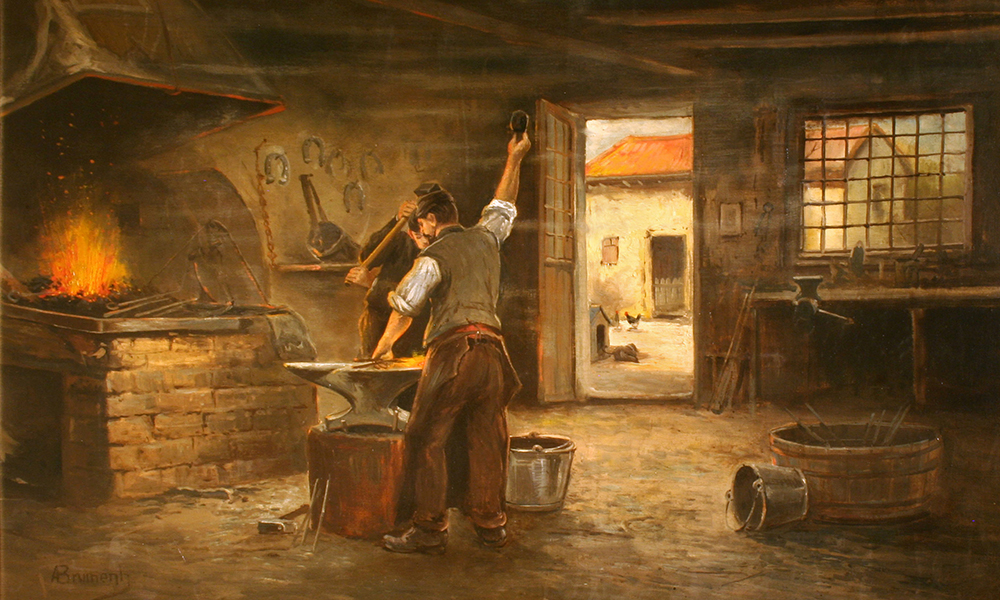
Rural trades like blacksmithing were integral to small communities, particularly in agricultural areas, but by the second half of the century modernization saw new agricultural technologies – such as ‘chill ploughs’ – being slowly introduced to these regions. These tools made farming more efficient but also reduced the demand for certain traditional trades. As seen in the letters from Duggan, this created anxiety and economic strain among rural artisans who felt threatened by technological advancements. These letters illustrate tensions within a rural Irish community navigating economic survival, technological change, and shifting landlord-tenant relationships. Duggan’s reliance on estate intervention reflects an old model of economic dependency, while Rochfort’s impartial response suggests the estate’s evolving stance away from direct intervention in tenants’ personal disputes.
A window into nineteenth-century rural Ireland
These letters provide a snapshot of the socio-economic changes in Ireland at the time, highlighting the vulnerability of local trades under modernization and the fading role of estates in protecting traditional livelihoods. Through Duggan’s use of subservient language, his dependency on estate decisions, and his lack of legal protections, these documents illustrate how the landowning class maintained control over economic and social life. For individuals like Duggan, Deady, and Sullivan, this imbalance left them vulnerable to external forces and limited their ability to exercise agency and power over their own lives. Ultimately, the letters reflect a rural society shaped by deeply rooted social hierarchies and structural inequalities, offering a stark insight into the realities of the era.
Please note all student submissions have been edited where necessary for accuracy and clarity.
- J. I. Falconer, ‘Land Reform in Ireland’ in Journal of Farm Economics, 6 (1924), p.346.[↩]
- Eoin McLaughlin, ‘Competing forms of cooperation? Land League, Land War and Cooperation in Ireland, 1879 to 1914’ in The agricultural history review, 63 (2015), p.89.[↩]
- Edmund Lodge, The Peerage of the British Empire. (1844) p.317.[↩]
- Anna Maria Hajba, ‘Viscount Lismore’s Tipperary Tenants’ in Tipperary Historical Journal, (2020), p.43.[↩]
- ‘Barony of Glenquin, 66, Feohanagh.’ Giffith’s Valuation of Ireland. Primary valuation of Tenaments. 1850-1858’ cited in ‘O’Callaghan (Lismore Shanbally)’ on Landed Estates Database: Ireland’s Landed estates and historic houses, c.1700–1914.[↩]
- Sir Bernard Burke, A genealogical and heraldic history of the landed gentry of Ireland 1814-1892, (London, 1912) p.601.[↩]
- John Barry. ‘Local Forges’. Material obtained from Mary Cronin, Dave Kelleher, Banteer, Co. Cork, The Schools’ Collection, (1930s), vol. 361, pp.608-10, National Folklore Collection, UCD.[↩]
- Tenants’ ledger, 1891-1902, (Special Collections and Archives UL, Timothey Looney Collection P43/79 26).[↩][↩]
- Mary Deady Letters, (Special Collections and Archives UL, Timothey Looney Collection P43/230 1).[↩]

You must be logged in to post a comment.