
by Olivia Lardner, Bolton Cataloguer
 In 1654, one of the original fellows of the Royal Society1 published Idea trigonometriæ demonstratæ (in usum juventutis Oxoniensis) (Oxford : Leonard Lichfield, 1654), now heavily annotated in the Bolton Library.


It may seem unusual to us, but its author Seth Ward (1617-1689) was actually a bishop. Not so unusual perhaps given that “his genius lay much to the mathematics”.2
Such interest in mathematics thankfully extended to our own collector-archbishops also, and led to the gathering together of wide-ranging material3 during the Enlightenment to form a collection which continues to be erroneously labelled today as ‘a religious collection’. Here we look at a selection of such material – two manuscripts and one early printed book – and we will begin with the oldest whole item in the collection.
Bolton Library Ms 1
Bolton Library Ms 1 has been studied in depth by the historian Charles Burnett4 and much of the mathematical content here stems from his research.
It is a tiny but stocky volume, measuring just 13 cm in height and yet comprising an impressive 350+ pp. It is a composite manuscript on parchment offcuts, compiled in England from the late twelfth century – its Paschal table bears the date 1168 – in possibly eight hands.

The contents of the work equate, in the humble opinion of this cataloguer, to the topics studied in the earliest of universities for the quadrivium, namely arithmetic, geometry, music, and astronomy. The possibility of it being a university textbook is underscored by the aforementioned use of ‘cheap’ offcuts in its construction and its handy, portable size. Any and all thoughts on this digression are of course welcome.
What concerns us here today is the manuscript’s mathematical leanings and its recurring pieces on the algorism, which introduced Arabic numerals and the concept of zero to European scholars for the first time. We still use them today.


The most momentous development in the history of pre-modern mathematics is the shift from using roman numerals to using Indian numerals … originally Sanskrit symbols that had been introduced into the Islamic world by the early ninth century … [in] Al-Khwarizmi’s ‘On the calculation of the Indians’ [and were] in turn, introduced to a Latin-reading public through a series of translations and adaptations produced from the early twelfth century onwards. This new kind of arithmetic became known as the algorism … and the numerals were described as being either Indian or Arabic.5
Throughout the manuscript we have short and lengthier pieces on the algorism, such as this complete text across pp 41-58, beginning “Nvmero[rum] diu[er]se s[un]t diff[e]r[enti]e”, which contains pieces on addition and subtraction, and in it we can see the use of zero.


On p 111 there begins the Helcep Sarracenicum by Johannes Ocreatus, distinctive for its use of the first nine roman numerals in teaching the algorism. Ocreatus was a student of Adelard of Bath (approximately 1090-1160), translator of al-Khwarizmi’s treatise and Euclid’s Elements.6 Ms 1 is one of just two known manuscripts to contain this text7, but this is probably unsurprising given the survival rate of manuscript material from what is now so many centuries ago.


We finish this embarrassingly shallow dive into the wonders of Ms 1 on p 14, with the numbers game unus trium vocetur binarius.

Bolton Library E.3.4A
In Archimedis opera qvae extant (Paris : Claude Morel, 1615), we find a Latin translation of the works of Archimedes by David Rivault de Flurance (approximately 1571-1616), mathematics tutor to the young King Louis XIII of France. It was to be his final work.

Our interest today, however, lies in another royal court, that of King Charles I of England.
On the title page here we find two instances of the marking ‘William Walker Eboracensis 1658’. This William Walker in/ from York was a learned man indeed, as this is an extensively annotated copy, with assiduous markings from front cover to back, and crammed onto three extra-illustrated leaves8 affixed by a pin behind the title page.


We have traced a reference to a William Walker “… a man of very good education, was especially skilled in mathematics, and popular with his Yorkshire neighbours.”9. These were not his only qualities, however, as apparently his skills also extended to the use of an axe. For this William Walker is purported to have been on duty at the execution of the king in 1649, and is indeed strongly suspected to have been the executioner himself. While the identity of the masked executioner on that day can never be known now with any certainty – two men with Galway connections are also strong contenders10 – Walker is believed to have stated on occasion that he was the one who wielded the axe. One for the researchers among you.
Bolton Library I.19.17(3)
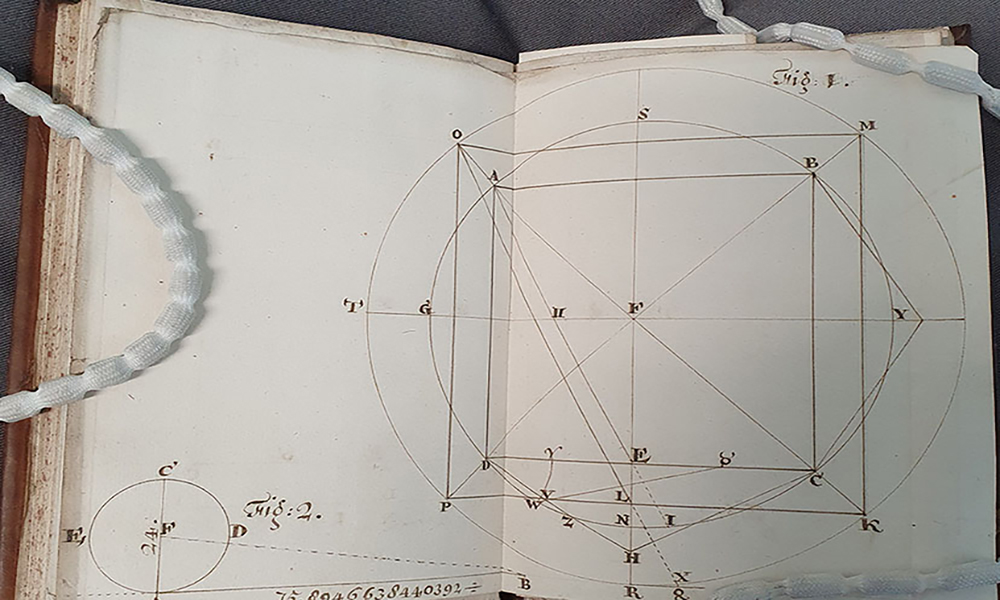
We finish today with a curious little manuscript, bound into a sammelband,11 one of many such structures in this collection. Quadrature or true squaring of any circle ([Dublin], 1712) is authored by William Nevill, who describes himself here as “A well wisher of the mathematic[s].” He declares the contents therein to be “all grounded on our grand Mr. Euclid”, and across less than 30 p six problems are discussed.


Our curiosity, however, stems from the fact that this “small treatise” – not only collected by collector-archbishop William King but also dedicated to him – never went to print. Why?

This is further exacerbated by the enigmatic author himself: who was William Nevill? This cataloguer is used to working with the smallest of clues and extrapolating theories thereupon, but the only possible match, albeit an extremely tentative one, has been found in the National Library of Ireland: an “accurate survey of part of the Honble. Colonel Wentworth Harman’s estate in the County of Longford” surveyed by a William Nevill in 1722.12
This William Nevill was listed as a surveyor active in Meath in 1726.13 Is William Nevill the surveyor also the Bolton Library’s ‘well wisher of the mathematics’? Another one for the researchers among you.

- Royal Society.[↩]
- Aubrey, J. (1982). Brief lives. Woodbridge, UK : Boydell Press, p. 316. Find it here.[↩]
- Find out more in A good eye.[↩]
- Burnett, C. (2013) “Music and the stars in Cashel, Bolton Library, MS 1” in Kelly, M. and Doherty, C., eds., Music and the stars : mathematics in medieval Ireland, Dublin: Four Courts Press, pp. 142-158 and Plates 6 and 7.[↩]
- Burnett, C. (2002). Learning Indian arithmetic in the early thirteenth century. Boletín de la Asociación Matemática Venezolana, 9(1), 15-26.[↩]
- “Adelard of Bath.” Complete Dictionary of Scientific Biography. Encyclopedia.com.[↩]
- Burnett, C. (2013). Ibid.[↩]
- Also known as grangerization; the inclusion of material by binder/ owner such as blank leaves, illustrations etc., not part of the original publication.[↩]
- Sidney, P. (1905). The headsman of Whitehall, Urbana-Champaign: University of Illinois, p. 46.[↩]
- Henry, W. (2002). Role of honour : the mayors of Galway City 1485-2001, Galway: Galway City Council, pp. 76-79. Find it here.[↩]
- Volume made up of separately produced works bound together, usually at the request of an owner.[↩]
- Brownrigg, J., Longfield, R.O., & Neville, W. (1784). An accurate survey of part of the Honble. Colonel Wentworth Harman’s estate in the County of Longford barony of Moydow and parish of Ballynacormick … taken by William Nevill in 1722 and copied by John Brownrigg in 1784. Scale of 40 perches to an inch. Table of reference showing denominations, tenants & acreage. NLI.[↩]
- Steer, F.W., Eden, P., & Adams, I. (1979) Dictionary of land surveyors and local cartographers of Great Britain and Ireland, 1550-1850, Folkestone: Dawson, p. 188. Find it here.[↩]

You must be logged in to post a comment.