

by Amelie Albrecht, Erasmus Student
Hermann Ludwig Heinrich von Pückler-Muskau is a famous name in Germany, but also around the world. His landscape art, a progression of the English garden style of the 19th century, and his extensive traveling reports from all around the world make Pückler a unique character of his time. Two of his most famous landscape parks, Bad Muskau and Branitz, are very near to where I come from, and I vividly remember wandering around there as a kid, feeling like I am walking straight through a fairy tale.
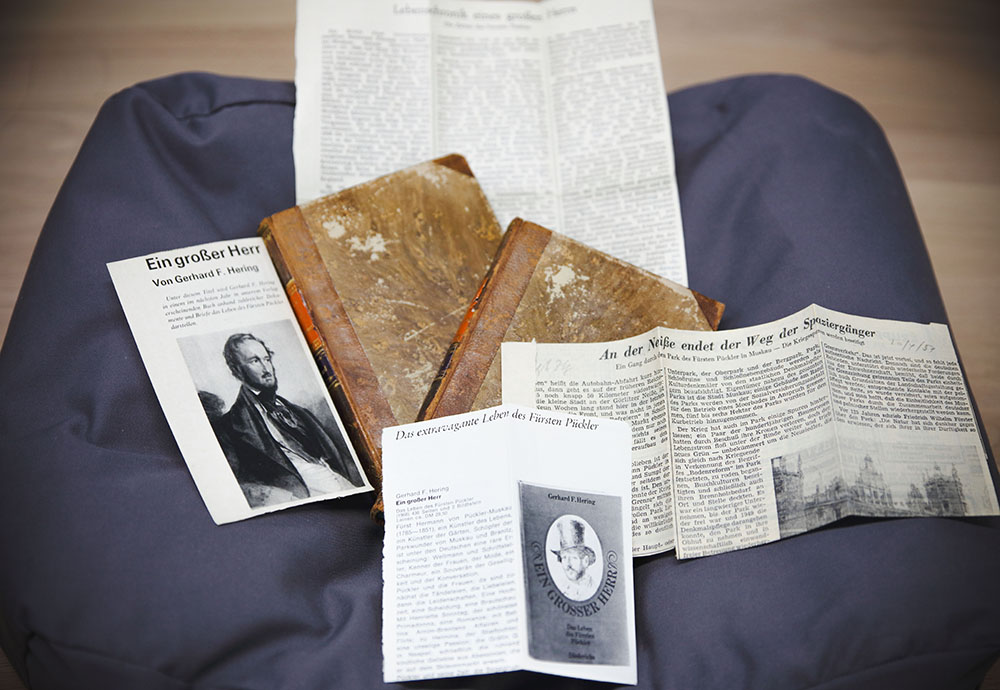
I was so delighted when I found these unique books written by Prince Pückler in the Gottschalk-collection. My name is Amelie Albrecht. I was an Erasmus-student from Germany who was more than happy to spend a month working in the Glucksman library at the University of Limerick and being able to help to assess the collection. Jürgen Gottschalk, founder of the Würzburg Irish-German Society, collected all printed materials about Ireland for decades, creating one of the largest private book collections on Ireland. The donation of his collection to the Glucksman Library created a wonderful resource for researchers and students alike.

Gottschalk collected several early editions of Pücklers most famous books “Briefe eines Verstorbenen” – ‘Letters of a Dead Man’, the ‘Dead Man’ being his pseudonym. Originally, these were letters written to his wife Lucie during his journey to England and Ireland, and it was her idea to publish them. First published in 1830 and 1831, his reports of landscape, culture and art even inspired Edgar Allan Poe, whose text ‘The Domain of Arnheim’ is strongly influenced by Pückler.

In 1828, Pückler visited Limerick, staying at Moriarty Hotel at 7 George Street and was introduced to the then newly established Limerick Independent Club. Pückler harshly criticised the displacement of the rural Irish population by the English nobles. He also has some funny things to say about the Irish, especially considering he travelled to England and Ireland mainly to find a wealthy wife that could help him financially with his landscape projects in Germany. Yes, Pückler had a wife in Germany, Lucie, but they divorced mainly so Pückler could marry a richer woman and him and Lucie could keep building their gardens. They still stayed together their whole life.

Pückler died 1871 at age 85 on the castle of Branitz, his remains are buried in a Pyramid-shaped tumulus in his gardens. He left the world his gardens and reports from around the world. In addition, what probably most German people know him by Fürst Pückler icecream, better known as Neapolitan ice cream. Pückler did not invent the ice cream, but gladly gave his name for it, after Julius Ferdinand Jungius, chef of the royal Prussian household, where Pückler often was a guest, dedicated the recipe to the Prince, who was known to enjoy a good ice cream dessert.

You must be logged in to post a comment.